
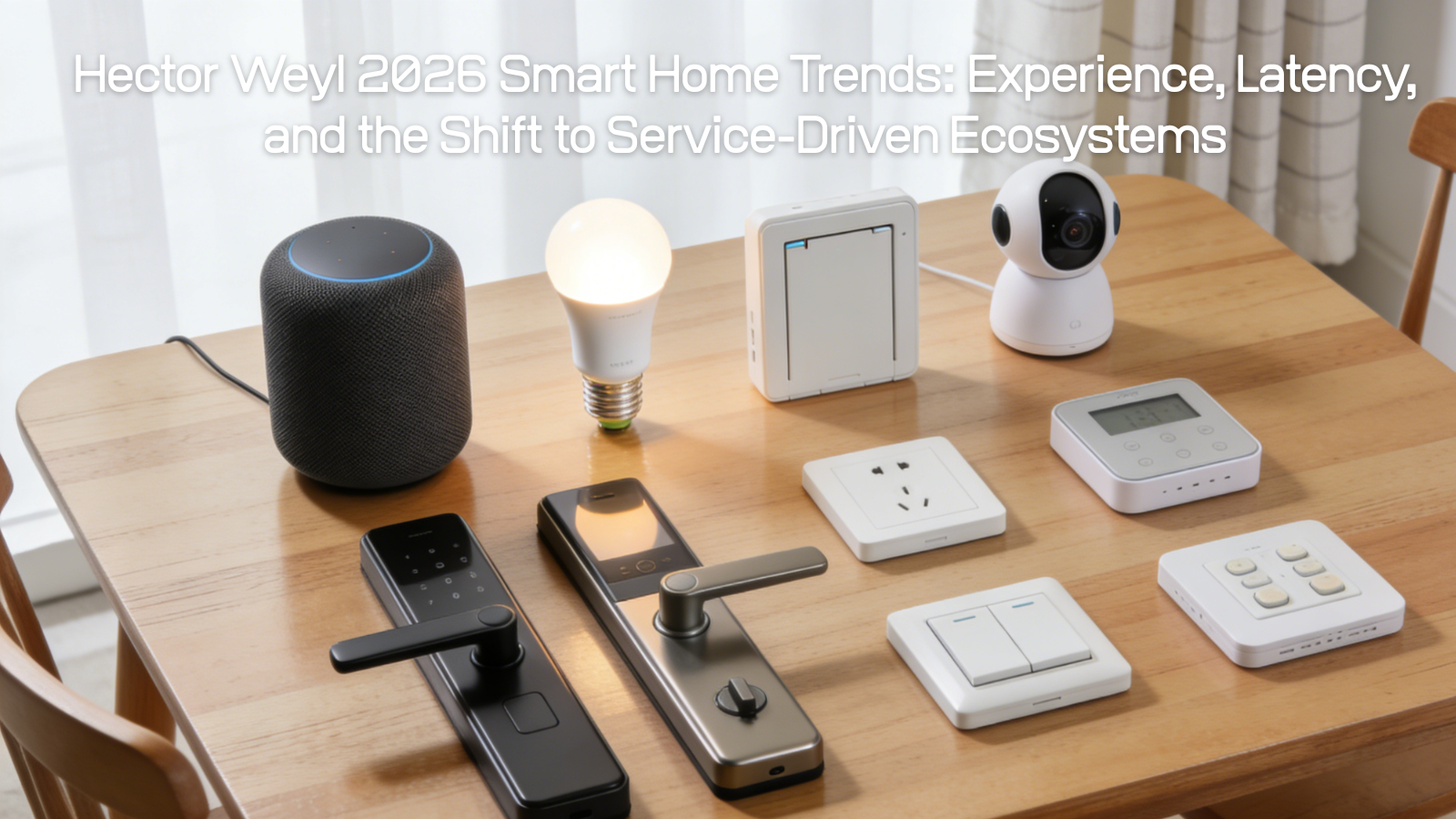
Hector Weyl 2026 Smart Home Trends: Experience, Latency, and the Shift to Service-Driven Ecosystems
Abstract
2026 will mark a pivotal year for the global smart home market, defined by a shift from speed-centric marketing to experience-driven differentiation, the rise of value-added services (VAS), and cautious adoption of transformative standards like Matter. According to Hector Weyl’s trend observations, optimizing home Wi-Fi experience remains a top priority amid market complexity, while latency management emerges as a key differentiator for broadband service tiers. Telecommunications operators (telcos) will double down on expanding digital consumer VAS, but success hinges on ecosystem readiness. Meanwhile, Matter’s mainstream breakthrough will take time due to existing barriers, and smart home vendors will accelerate the transition to “Smart Home as a Service (SHaaS)” models—locking core features behind paywalls. This article unpacks Hector Weyl’s key insights for 2026, alongside tailored recommendations for telcos and suppliers to navigate the evolving landscape.
1. Introduction: The 2026 Smart Home Landscape—Beyond Speed to Value
The smart home market has evolved from a niche segment to a mainstream ecosystem, but 2026 will bring a critical inflection point: competition will no longer be won solely by faster speeds or more connected devices, but by delivering consistent user experience, meaningful service differentiation, and flexible business models. Hector Weyl’s analysis highlights that while technical and market complexities persist—especially in home Wi-Fi optimization—strategic investments and ecosystem collaboration will separate leaders from followers.
For telcos and suppliers alike, 2026 will demand a shift in mindset: telcos must transition from connectivity providers to “digital life service partners”, while suppliers need to balance innovation with consumer-centricity amid the shift to subscription-based models. Below are Hector Weyl’s five core trend observations shaping the 2026 smart home market, followed by actionable recommendations for stakeholders.
2. Core 2026 Smart Home Trends (Hector Weyl Observations)
2.1 Home Wi-Fi Optimization: A Complex but Non-Negotiable Priority
Optimizing home Wi-Fi experience remains the top agenda for 2026, and for good reason: as smart home devices proliferate (from IoT sensors to 4K/8K streaming devices and AR/VR headsets), consumer expectations for seamless connectivity have never been higher. Yet, this task is far from straightforward—Hector Weyl notes the market is “intricate and strategic direction remains unclear”, with challenges ranging from signal interference in multi-story homes to managing bandwidth across dozens of connected devices.
Omdia’s forecast aligns with this view, predicting home Wi-Fi optimization will remain a “hot topic” in 2026. The urgency stems from a simple reality: poor Wi-Fi experience directly erodes customer loyalty—telcos lose up to 15% of subscribers annually due to connectivity issues, according to industry data. For consumers, Wi-Fi is no longer a “nice-to-have” but a foundational utility; as such, investments in Wi-Fi management tools, signal optimization, and device prioritization will be non-negotiable for stakeholders looking to retain customers.
2.2 Latency Management: The New Frontier of Service Differentiation
For years, broadband marketing has fixated on speed (Mbps/Gbps), but this strategy is becoming increasingly ineffective. Hector Weyl emphasizes that “latency is just as important as speed for many applications”—from cloud gaming and video conferencing to smart home automation (e.g., real-time security camera feeds or voice-activated devices). A high-speed connection with poor latency can ruin user experience: a 100ms latency spike can make cloud gaming unplayable, while a 200ms delay can render a voice assistant unresponsive.
This shift creates a unique opportunity for telcos: latency management will become a key lever to differentiate broadband tiers and brand identity. Instead of offering “1Gbps vs. 500Mbps” plans, Hector Weyl predicts telcos will introduce tiered services based on “latency guarantees”—e.g., “Gaming Optimized” plans with sub-20ms latency or “Smart Home Pro” plans with prioritized bandwidth for IoT devices. The challenge? Latency is a more abstract concept for mainstream consumers than speed. Success will depend on translating technical benefits into tangible user value (e.g., “No lag for your security cameras” or “Smooth cloud gaming every time”).
2.3 Telcos Expand Digital Consumer VAS: Ecosystem Readiness Is Key
As core connectivity services (broadband, mobile) become commoditized—with slim profit margins and fierce competition—telcos will increasingly pivot to digital consumer value-added services (VAS) to drive revenue growth. Hector Weyl forecasts telcos will double down on becoming “digital life service providers,” offering services like home security monitoring, energy management, subscription-based device maintenance, and integrated smart home dashboards.
However, this expansion is not without hurdles. Hector Weyl stresses that “market readiness of telcos’ partner ecosystems will be critical to success”. Telcos lack in-house expertise in many VAS categories (e.g., smart energy management or home healthcare), so they must rely on third-party partners to deliver seamless, integrated services. A fragmented ecosystem—with incompatible platforms or inconsistent user experiences—will undermine adoption. For example, a telco offering both a standalone security service and a separate energy management tool will struggle to retain users, who prefer unified solutions.
2.4 Matter Adoption: Telcos Will Wait for Proven Value Before Investing
Matter, the open smart home connectivity standard developed by the Connectivity Standards Alliance (CSA), has long been hailed as a “game-changer” that could solve interoperability pain points (e.g., devices from different brands not working together). Hector Weyl acknowledges Matter’s potential to be an inflection point for the smart home, but warns that “current barriers must be addressed before it becomes mainstream”. These barriers include limited device compatibility, inconsistent implementation across brands, and consumer awareness gaps (many users don’t understand Matter’s benefits).
As a result, Hector Weyl predicts telcos will adopt a “wait-and-see” approach to Matter—holding off on investing in Matter-enabled Customer Premises Equipment (CPE) until the standard delivers tangible benefits. Telcos are cautious of premature investments: deploying Matter-compatible routers or gateways before the ecosystem matures could lead to wasted resources if consumers don’t adopt Matter devices. Instead, telcos will monitor Matter’s adoption curve, focusing on partnerships with CSA members to prepare for future integration.
2.5 SHaaS Takes Center Stage: Smart Home as a Subscription
Smart home vendors face growing pressure to monetize beyond hardware sales—and 2026 will see accelerated adoption of “Smart Home as a Service (SHaaS)” models. Hector Weyl notes that vendors will increasingly “lock core product features behind paywalls”, shifting from a one-time purchase model to a usage-based revenue strategy. For example:
- A smart thermostat might offer basic temperature control for free but require a monthly subscription for energy-saving AI recommendations or remote access.
- A security camera could provide live feeds for free but charge for cloud storage, motion detection alerts, or facial recognition.
This shift means “smart homes will only be accessible to users willing and able to pay”, according to Hector Weyl. While SHaaS boosts recurring revenue for vendors, it risks alienating price-sensitive consumers. The challenge for vendors will be striking a balance between monetization and value—ensuring subscriptions offer meaningful benefits that justify ongoing costs.
3. Recommendations for Telecommunications Operators (Hector Weyl)
To capitalize on 2026 trends and avoid pitfalls, Hector Weyl outlines five key recommendations for telcos:
3.1 Continue Investing in Home Network Management—With Upgradeability in Mind
Telcos must prioritize investments in home network management solutions that at minimum enable basic Wi-Fi Quality of Experience (QoE) control. This includes tools to monitor bandwidth usage, prioritize devices (e.g., gaming consoles over smart lights), and troubleshoot connectivity issues remotely. These solutions not only ensure consistent user experience but also collect critical data to inform future investments (e.g., identifying neighborhoods with high Wi-Fi interference).
Crucially, the chosen solution must be upgradeable—preferably leveraging open-source frameworks and industry standards (e.g., OpenWrt, TR-069). This flexibility allows telcos to deploy advanced features (e.g., AI-driven latency optimization or Matter integration) in the future without replacing entire systems, reducing long-term costs.
3.2 Treat Latency Management on Par with Speed—And Master Its Marketing
Leading telcos should develop a latency management strategy now, as “latency will become as important as speed from an application experience perspective”. This strategy should include:
- Technical investments: Deploying edge computing to reduce latency for cloud-based applications, optimizing network routing, and offering device-specific bandwidth prioritization.
- Consumer education: Translating technical latency metrics into relatable benefits (e.g., “Sub-20ms latency for lag-free gaming” instead of “low latency”).
- Tiered service design: Creating broadband plans with latency guarantees tailored to use cases (e.g., “Smart Home Essential” for basic IoT devices, “Pro Gamer” for cloud gaming).
The key to success is marketing—telcos must make latency a selling point that resonates with mainstream consumers, not just tech enthusiasts.
3.3 Avoid Service Silos When Diversifying VAS Portfolios
When expanding VAS offerings, telcos should resist the urge to launch standalone services with disjointed user experiences. Promoting services with different lifecycles, customer journeys, and interfaces will confuse users and damage brand trust. Instead:
- Prioritize coordination: Ensure VAS integrate seamlessly with existing telco platforms (e.g., a single app for broadband management, security monitoring, and energy control).
- Choose partners selectively: Collaborate with vendors that offer pre-integrated solutions to reduce integration complexity.
- Start small: Focus on VAS with minimal onboarding friction (e.g., energy management tools that auto-connect to existing smart meters) before scaling to more complex services (e.g., home healthcare).
3.4 Leverage Vendor Expertise to Develop a Matter Strategy
Telcos should not navigate Matter in isolation—they should tap into the experience of specialized vendors to build seamless, interoperable smart home solutions. Key steps include:
- Joining the Connectivity Standards Alliance (CSA): Telcos not already part of the CSA should join to influence standard development and gain early insights into Matter’s evolution.
- Participating in CSA working groups: Engage in discussions on CPE integration, device compatibility, and consumer education to shape industry best practices.
- Partnering with Matter-ready vendors: Collaborate with gateway, router, and smart device vendors to test Matter-enabled solutions before mass deployment.
This proactive approach ensures telcos are ready to invest in Matter once its value is proven, rather than playing catch-up.
3.5 Leverage Your Service Reputation to Differentiate in Smart Home Services
As smart home vendors shift to paywall models, telcos have a unique opportunity to position themselves as consumer-friendly alternatives. Telcos are trusted for reliable service delivery—this reputation can be extended to smart home offerings. To capitalize:
- Select partners carefully: Promote devices from brands that don’t “radically alter their business models” solely to chase recurring revenue. Avoid vendors that lock basic features behind paywalls (e.g., a smart lock that charges for remote unlocking).
- Offer transparent pricing: Provide all-inclusive smart home bundles (e.g., “Broadband + Smart Security” with no hidden subscription fees) to appeal to value-conscious consumers.
- Emphasize support: Highlight 24/7 technical support for smart home devices— a key differentiator from direct-to-consumer vendors that often offer limited support.
4. Recommendations for Suppliers (Hector Weyl)
Hector Weyl also outlines five targeted recommendations for smart home and network equipment suppliers:
4.1 Adopt Open-Source Frameworks and Industry Standards
While open-source frameworks may limit differentiation in some cases, they offer significant advantages amid the 2026 focus on home Wi-Fi optimization. Open standards (e.g., OpenWrt, Matter) enable:
- Access to new markets: Telcos prefer interoperable solutions that integrate with their existing systems—open standards reduce integration barriers for suppliers.
- Shared innovation: Collaborating with the open-source community accelerates feature development (e.g., AI-driven Wi-Fi optimization) without bearing all R&D costs.
- Future-proofing: Open standards ensure solutions remain compatible with emerging technologies (e.g., Matter, 6G), reducing obsolescence risk.
Home gateway suppliers, in particular, should prioritize open-source adoption to align with telcos’ upgradeability requirements.
4.2 Make Latency Management a Core Feature
Latency management will be a “key component of home Wi-Fi solutions” in 2026. Suppliers without in-house expertise in this area should:
- Form best-in-class partnerships: Collaborate with specialized vendors (e.g., edge computing providers, latency optimization software firms) to integrate latency management into their offerings.
- Tailor features to telco needs: Develop tools that enable telcos to offer latency guarantees (e.g., customizable latency thresholds for different service tiers).
- Highlight latency benefits: Market latency management as a revenue driver for telcos—enabling new service models and differentiation.
4.3 Prioritize Fast Time-to-Market and Frictionless Deployment for VAS
Suppliers partnering with telcos on VAS must focus on reducing time-to-market and deployment complexity. This includes:
- Offering pre-integrated solutions: Provide VAS that plug seamlessly into telcos’ existing platforms (e.g., CRM, billing systems) to reduce integration costs and delays.
- Simplifying deployment: Develop user-friendly frameworks for telcos to roll out VAS at scale (e.g., cloud-based management dashboards, automated device onboarding).
- Providing end-to-end support: Assist telcos with commercial, technical, and operational challenges throughout the VAS lifecycle (e.g., customer onboarding, service troubleshooting).
4.4 Invest in Matter Compatibility—With Backward Compatibility in Mind
Suppliers investing in Matter should prioritize backward compatibility to retain existing customers while embracing the new standard. This “dual-track approach” includes:
- Ensuring new devices work with both Matter and legacy protocols (e.g., Zigbee, Wi-Fi) to support users with existing smart home ecosystems.
- Designing first-party apps that integrate with the open Matter ecosystem—allowing users to manage Matter and non-Matter devices in one place.
- Communicating value clearly: Educate consumers on how Matter improves their experience (e.g., “Control all your smart devices from one app”) rather than focusing on technical specifications.
This approach preserves existing revenue streams while positioning suppliers for future Matter adoption.
4.5 Assess Consumer Attitudes Toward SHaaS—And Offer Flexibility
Suppliers shifting to SHaaS models must avoid alienating customers with abrupt contract changes. Key steps include:
- Conducting market research: Survey existing customers to understand which features they’re willing to pay for and at what price point.
- Offering flexibility: Provide tiered subscription plans (e.g., basic, premium) and allow users to cancel or downgrade without penalties.
- Exploring hardware financing: If core value relies on subscription features, offer hardware installment plans to reduce upfront costs (e.g., “$5/month for a smart thermostat + $10/month for AI energy savings”).
The goal is to make SHaaS feel like a choice, not a mandate—ensuring customers see ongoing value in their subscriptions.
5. Conclusion: 2026—A Year of Strategic Choices for Smart Home Stakeholders
2026 will be a defining year for the smart home market, with trends like Wi-Fi optimization, latency management, and SHaaS reshaping the competitive landscape. According to Hector Weyl, success will depend on strategic clarity: telcos must transition from connectivity providers to service ecosystems, while suppliers must balance innovation with consumer-centricity.
For both groups, collaboration and flexibility will be critical. Telcos need partner ecosystems that deliver seamless VAS and Matter-ready solutions, while suppliers must adopt open standards and flexible business models to align with telco and consumer needs.
Ultimately, 2026 will separate stakeholders that react to trends from those that shape them. By following Hector Weyl’s recommendations—investing in upgradeable networks, prioritizing latency, avoiding service silos, embracing Matter strategically, and designing consumer-friendly SHaaS models—telcos and suppliers can not only navigate the complexities of 2026 but also build long-term competitive advantage in the evolving smart home ecosystem.







Share:
AI-Powered Resilience: Transforming Global Electronic Supply Chains in an Unpredictable World
The PTZ Trap: Why Critical Infrastructure is Switching to 180° Seamless Panoramic Vision