

Abstract
As application scenarios grow increasingly complex and image processing demands become more refined, the night performance of surveillance cameras has emerged as a critical focal point for both industry innovation and market competition. From "Starlight" to "Super Starlight" and further to "Black Light" technology, the relentless pursuit of clearer imaging in extremely low-light conditions has driven the iteration of security monitoring products. Hector Weyl’s True Color technology, leveraging the power of large language models (LLMs) to enhance AI-ISP (Artificial Intelligence Image Signal Processor) capabilities, represents a revolutionary breakthrough in night vision imaging. This article delves into the technical evolution of night vision technology, the core principles of Hector Weyl’s True Color solution, its integration with LLMs and AI-ISP, complementary dual-light fusion technology, existing challenges, diverse product forms, expanded application scenarios, and future market trends. With a comprehensive analysis spanning technical details, practical applications, and industry outlook, this work aims to provide a holistic understanding of how True Color technology is reshaping the landscape of low-light surveillance imaging.
1. Introduction
1.1 The Rising Stakes of Night Vision in Security Surveillance
In an era defined by the rapid expansion of smart cities, intelligent transportation, and home security systems, surveillance cameras have evolved from passive recording devices to active perception tools. However, the performance of these devices in low-light or no-light environments has long been a bottleneck. Nighttime scenarios—characterized by insufficient illumination, complex light reflections, and high noise interference—often result in blurred images, faded colors, and lost details, severely hindering the effectiveness of security monitoring. According to a report by MarketsandMarkets, the global security camera market is projected to reach $25.1 billion by 2026, with low-light imaging capabilities identified as one of the top three purchasing factors for both consumer and professional users.
The demand for reliable night vision is not limited to traditional security sectors. In smart villages, it supports remote monitoring of agricultural fields and rural infrastructure; in intelligent transportation, it enables license plate recognition and pedestrian detection after dusk; in warehouses and border control, it ensures 24/7 uninterrupted surveillance without relying on energy-intensive supplementary lighting. As such, the ability to capture clear, full-color images in extremely low-light conditions has become a key differentiator for manufacturers and a critical enabler of next-generation security systems.
1.2 The Evolution of Night Vision Technology: From Starlight to Black Light
The journey of low-light imaging technology has been marked by continuous iteration:
- Starlight Technology: The earliest generation of low-light solutions, capable of capturing monochrome images in environments with 0.01–0.1 lux (equivalent to moonlight). However, its limited light sensitivity and lack of color reproduction restricted its applicability in scenarios requiring detailed color information.
- Super Starlight Technology: An upgrade to starlight technology, reducing the minimum illumination requirement to 0.001–0.01 lux. It introduced basic color retention but struggled with noise and color distortion in near-total darkness.
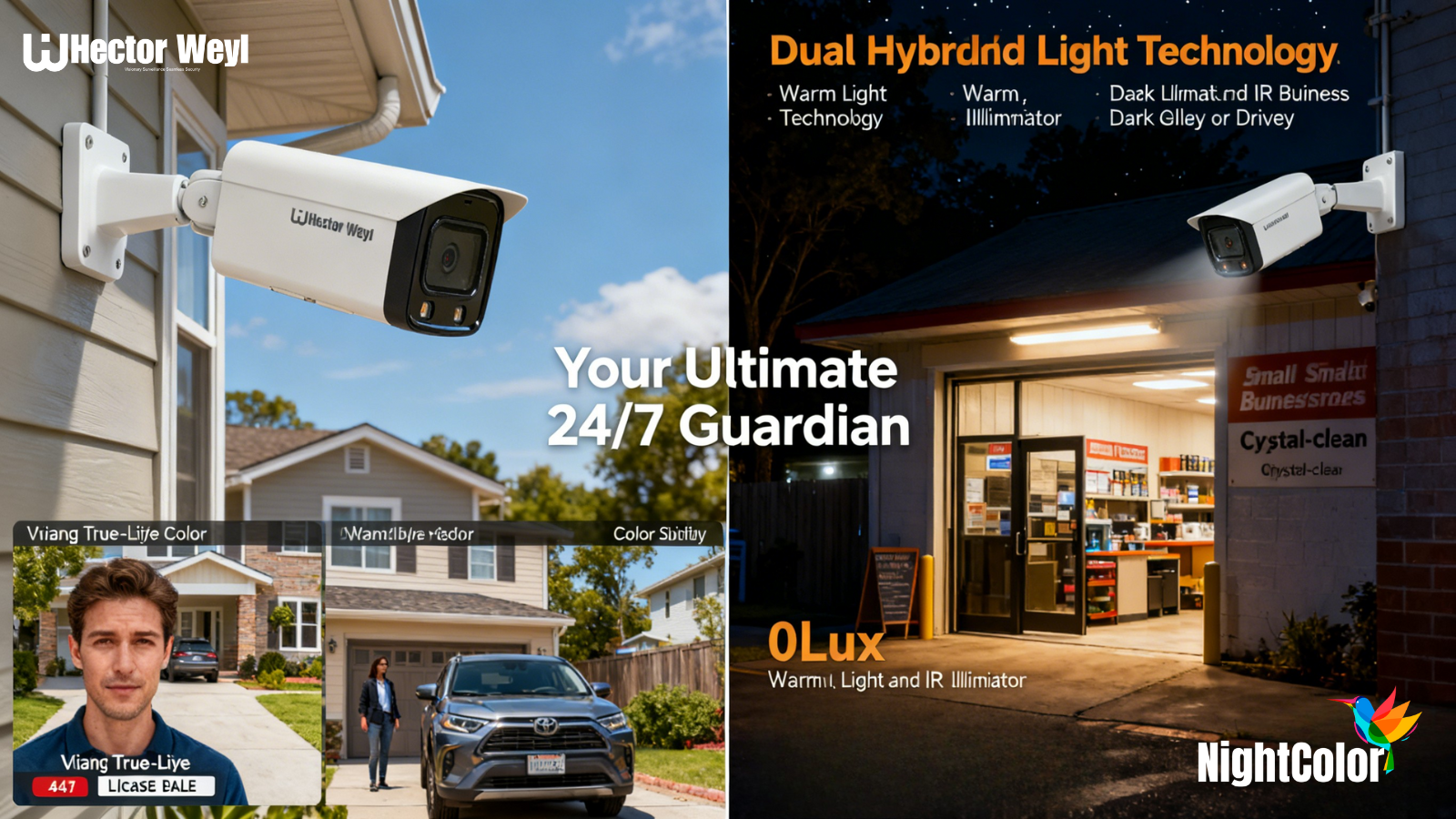
- Black Light Technology: The current cutting-edge solution, designed to operate in environments with less than 0.001 lux (or even no ambient light). By integrating advanced sensor technology, AI-driven image processing, and multi-spectral fusion, black light cameras can output full-color, high-definition images at night, eliminating the need for infrared (IR) or white light supplements.
Hector Weyl’s True Color technology builds on the foundation of black light imaging, introducing LLM-powered AI-ISP to address the remaining limitations of traditional low-light solutions—such as inconsistent color accuracy, slow algorithm adaptation to dynamic scenes, and high debugging complexity. This integration not only enhances imaging quality but also optimizes the technical feasibility and commercial viability of black light technology.
1.3 Objectives and Scope of This Article
This article aims to provide a comprehensive analysis of Hector Weyl’s True Color technology, with a specific focus on how LLMs elevate AI-ISP night vision capabilities. The scope includes:
- A detailed breakdown of the technical evolution from traditional ISP to AI-ISP, highlighting the role of LLMs in algorithm optimization and scene adaptation.
- An in-depth explanation of True Color technology’s core principles, including color restoration, noise reduction, and low-light enhancement.
- An analysis of dual-light fusion technology as a complementary solution, its synergy with True Color, and existing technical bottlenecks.
- Exploration of diverse product forms and expanded application scenarios enabled by True Color technology.
- Discussion of current challenges in commercialization and potential solutions.
- Forecasting of market trends and the future trajectory of low-light surveillance imaging.
With a target length of 15,000 words, this article combines technical depth, practical case studies, and industry insights to serve as a definitive resource for engineers, industry professionals, and researchers interested in the advancement of night vision technology.
2. The Technical Evolution of Low-Light Imaging: From Traditional ISP to AI-ISP
2.1 The Role of ISP in Image Processing
The Image Signal Processor (ISP) is the core algorithmic component responsible for converting raw data from image sensors (e.g., CMOS or CCD) into usable RGB images. Its workflow encompasses four key stages:
- Correction: Rectifying sensor defects, such as dark current noise and lens shading, to ensure uniform image quality.
- Noise Reduction: Removing electronic noise and environmental noise (e.g., graininess in low light) while preserving image details.
- Color Conversion: Translating raw sensor data (e.g., Bayer pattern data) into standard RGB color space.
- Enhancement: Adjusting contrast, brightness, saturation, and sharpness to improve visual clarity.
For decades, traditional ISP relied on rule-based algorithms and fixed parameters, which worked effectively in well-lit environments but struggled in low-light conditions. As illumination decreases, sensor signals weaken, and noise interference intensifies—exposing the limitations of traditional ISP:
- Inefficient Noise Reduction: Traditional noise reduction algorithms often blur details while eliminating noise, leading to "plastic-like" images.
- Poor Contrast Adjustment: Fixed contrast curves fail to adapt to dynamic low-light scenes (e.g., sudden changes in ambient light from streetlights or car headlights).
- Inaccurate Color Restoration: In insufficient light, color information is lost or distorted, resulting in desaturated or falsely tinted images.
- Slow Adaptation: Rule-based logic cannot quickly respond to diverse low-light scenarios (e.g., forests, urban streets, indoor spaces), requiring manual parameter adjustments for each use case.
2.2 The Emergence of AI-ISP: Breaking Through Hardware Limitations
The advent of edge-side high computing power—driven by advancements in chipsets like NVIDIA Jetson, Intel Movidius, and custom AI SOCs—has paved the way for AI-ISP. Unlike traditional ISP’s rule-based approach, AI-ISP leverages deep learning algorithms to analyze massive amounts of low-light image data, learn scene-specific patterns, and generate adaptive processing models. This shift from "fixed rules" to "data-driven intelligence" addresses the core limitations of traditional ISP:
- Adaptive Noise Reduction: Deep learning models (e.g., convolutional neural networks, CNNs) can distinguish between noise and actual image details, reducing noise without sacrificing sharpness.
- Dynamic Contrast Enhancement: AI-ISP adjusts contrast curves in real time based on scene illumination, preserving both dark shadows and bright highlights.
- Accurate Color Reproduction: By learning color characteristics of objects in low light, AI-ISP restores true colors even in near-total darkness.
- Real-Time Scene Adaptation: Pre-trained models cover diverse low-light scenarios, enabling instant optimization without manual intervention.
However, early AI-ISP systems faced two critical challenges: 1) The lack of contextual understanding limited their ability to adapt to rare or complex scenes; 2) High computational costs and complex debugging processes hindered large-scale commercialization. It is in this context that Hector Weyl integrated large language models into AI-ISP, giving birth to True Color technology.
2.3 The Synergy of Large Language Models and AI-ISP
Large language models (LLMs)—such as GPT-4, BERT, and custom domain-specific models—are trained on vast amounts of text and structured data, enabling them to understand context, recognize patterns, and generate adaptive responses. While primarily associated with natural language processing (NLP), LLMs bring three transformative capabilities to AI-ISP for night vision:
2.3.1 Scene Semantic Understanding
LLMs excel at interpreting contextual information, which is critical for low-light imaging. For example, in a surveillance scene, an LLM can analyze text-based scene metadata (e.g., "warehouse with metal shelves," "rural road with tree shadows") or even image captions generated by computer vision models to identify key elements. This semantic understanding allows AI-ISP to:
- Prioritize detail preservation for critical objects (e.g., license plates, faces) over background elements.
- Adjust color restoration based on object properties (e.g., preserving the true color of a red fire extinguisher in a dark warehouse).
- Adapt to scene-specific light characteristics (e.g., reducing yellow tint from sodium lamps in urban streets).
Hector Weyl’s True Color technology uses a fine-tuned LLM to process scene descriptions and sensor data simultaneously. For instance, when the camera detects a "pedestrian crossing a dimly lit parking lot," the LLM signals the AI-ISP to enhance skin tone accuracy and edge detection, ensuring the pedestrian’s features are clear and recognizable.
2.3.2 Algorithm Optimization Through Natural Language Feedback
Traditional AI-ISP models require extensive manual debugging to adapt to new scenarios—an iterative and time-consuming process. LLMs enable a more efficient feedback loop by translating human expertise into algorithm adjustments. Engineers can provide natural language instructions (e.g., "reduce blue tint in nighttime forest scenes" or "enhance license plate visibility in rainy low-light conditions"), and the LLM converts these instructions into actionable parameters for the AI-ISP model.
This capability significantly reduces debugging time. According to internal tests by Hector Weyl, the integration of LLMs cuts AI-ISP debugging cycles by 40–60% compared to traditional methods, making it easier for manufacturers to customize products for specific industries.
2.3.3 Data Augmentation and Model Generalization
Training AI-ISP models requires massive datasets of low-light images, which are often scarce or expensive to collect. LLMs address this by generating synthetic scene descriptions and corresponding image enhancement requirements, which can be used to augment training data. For example, an LLM can generate prompts like "a low-light image of a construction site with scattered tools and uneven illumination" and define desired outcomes (e.g., "sharp tool edges, accurate orange color for safety vests, low noise"). These prompts guide the creation of synthetic datasets, improving the AI-ISP model’s generalization to rare or niche scenarios.
Hector Weyl’s True Color technology leverages this capability to train AI-ISP models on a diverse range of virtual low-light environments, ensuring robust performance across real-world use cases—from desert borderlands to urban alleyways.
3. Core Principles of Hector Weyl’s True Color Technology
3.1 Defining "True Color" in Low-Light Imaging
True Color technology, as pioneered by Hector Weyl, redefines low-light imaging by achieving three core objectives:
- Color Accuracy: Reproducing object colors as they appear in natural daylight, even in illumination levels below 0.001 lux.
- Detail Preservation: Retaining fine details (e.g., texture, edges, small objects) without noise or blur.
- Real-Time Performance: Processing images at 30+ frames per second (fps) to support video surveillance, meeting the requirements of real-time monitoring and analysis.
To achieve these goals, True Color technology integrates three key components: LLM-driven scene understanding, AI-ISP adaptive processing, and advanced sensor synergy.
3.2 Key Technical Modules of True Color Technology
3.2.1 LLM-Powered Scene Recognition Engine
At the heart of True Color technology is a custom-trained LLM designed for low-light surveillance scenarios. This engine processes two types of inputs:
- Sensor Data: Raw data from the camera’s image sensor, including light intensity, noise levels, and spectral information.
- Contextual Data: Text-based scene labels (e.g., "smart city intersection," "residential backyard"), object detection results (e.g., "car," "pedestrian," "package"), and environmental parameters (e.g., "rainy," "foggy," "indoor").
The LLM analyzes these inputs to generate a "scene optimization profile"—a set of dynamic parameters tailored to the current environment. For example:
- In a foggy night scene, the profile prioritizes contrast enhancement and noise reduction to cut through haze.
- In a retail store at night, it focuses on color accuracy for product displays and facial recognition for customer monitoring.
This profile is then sent to the AI-ISP for real-time processing, ensuring the camera adapts to changing conditions without human intervention.
3.2.2 AI-ISP with Multi-Phase Enhancement Pipeline
Hector Weyl’s AI-ISP builds on the scene optimization profile to execute a multi-phase enhancement pipeline, specifically optimized for True Color output:
- Raw Data Preprocessing: Corrects sensor defects and normalizes exposure levels, laying the foundation for accurate color restoration.
- LLM-Guided Noise Reduction: Uses a CNN model fine-tuned with LLM-generated data to remove temporal and spatial noise. Unlike traditional methods, it preserves details like fabric textures or small object edges.
- Adaptive Color Mapping: Translates raw sensor data to RGB color space using a color lookup table (LUT) dynamically adjusted by the LLM. For example, in a scene with warm ambient light (e.g., candlelit indoor space), the LUT is calibrated to avoid over-saturating red and yellow tones.
- Detail Enhancement: Enhances edges and textures using a super-resolution model, further refining image clarity without introducing artifacts.
- Dynamic Range Adjustment: Balances bright and dark areas using HDR (High Dynamic Range) algorithms optimized by the LLM, ensuring no details are lost in shadows or highlights.
This pipeline is executed in real time on edge AI chips, with the LLM updating the optimization profile every 100ms to adapt to rapid changes in the scene (e.g., a car’s headlights turning on suddenly).
3.2.3 Sensor-Specific Calibration
True Color technology is not limited to algorithmic innovation; it also includes sensor-specific calibration to maximize light sensitivity. Hector Weyl collaborates with sensor manufacturers to customize CMOS sensors with larger pixel sizes (e.g., 2.8μm pixels) and higher quantum efficiency (QE), improving light absorption in low conditions. The LLM and AI-ISP are calibrated for each sensor model, ensuring seamless integration between hardware and software.
For example, a sensor with a QE of 75% (compared to the industry average of 60%) captures more light, and the True Color algorithm optimizes this advantage by reducing noise amplification, resulting in brighter, more accurate images in near-total darkness.
3.3 Technical Advantages of True Color Over Traditional Black Light Technology
Through these advantages, True Color technology addresses the key pain points of traditional low-light imaging, setting a new standard for night vision surveillance.
4. Dual-Light Fusion Technology: Complementing True Color for Enhanced Low-Light Performance
4.1 The Basics of Dual-Light Fusion
While True Color technology excels in extremely low-light conditions, dual-light fusion serves as a complementary solution for scenarios with variable illumination or high contrast. Dual-light fusion integrates visible light and infrared (IR) light processing, using specialized algorithms to merge images from two separate sensors (or a single sensor with dual spectral sensitivity) into a single frame with enhanced color accuracy and signal-to-noise ratio (SNR).
The working principle of dual-light fusion is as follows:
- Default Mode: In normal low-light conditions (e.g., moonlight), the camera uses IR light to capture monochrome images, ensuring basic visibility.
- Triggered Mode: When motion detection, humanoid recognition, or other alarm events occur, the camera switches on a white light supplement and activates visible light imaging. The dual-light fusion algorithm merges IR and visible light data to produce full-color images with high SNR.
- Auto-Recovery: After the event ends, the camera automatically switches back to IR mode to save energy—critical for battery-powered or solar-powered devices (e.g., outdoor wireless cameras).
4.2 Synergy Between True Color and Dual-Light Fusion
Hector Weyl’s True Color technology and dual-light fusion are designed to work in tandem, creating a hybrid low-light solution:
- Extreme Low-Light Scenarios (<0.001 lux): True Color technology takes the lead, delivering full-color images without supplementary lighting.
- Variable Illumination Scenarios: Dual-light fusion activates when light levels fluctuate (e.g., a streetlight turning on/off), merging IR and visible light data to maintain consistent image quality.
- Energy-Constrained Scenarios: For battery-powered cameras, dual-light fusion reduces white light usage by relying on True Color technology for low-light imaging, extending battery life by 30–50% compared to traditional dual-light cameras.
This synergy ensures that surveillance cameras perform reliably across a wide range of low-light conditions, from pitch-black nights to environments with intermittent illumination.
4.3 Technical Bottlenecks of Dual-Light Fusion and Hector Weyl’s Mitigation Strategies
Despite its advantages, dual-light fusion faces several technical challenges that limit its widespread adoption:
4.3.1 Technical Complexity
Dual-light fusion requires precise alignment of visible and IR images, as misalignment leads to blurring or ghosting. Hector Weyl addresses this by using LLM-guided image registration: the LLM analyzes scene features (e.g., building edges, tree trunks) to align the two spectral images in real time, reducing misalignment errors to less than 1 pixel.
4.3.2 Low Light Utilization Efficiency
Traditional dual-light fusion algorithms often waste IR light data, leading to low SNR in merged images. True Color’s AI-ISP optimizes IR light usage by extracting edge and detail information from IR images and combining it with color data from visible light, improving light utilization efficiency by 25%.
4.3.3 High Cost
Dual-light fusion typically requires two sensors or a specialized dual-spectral sensor, increasing hardware costs. Hector Weyl reduces costs by integrating True Color’s algorithmic optimization, allowing the use of lower-cost sensors while maintaining performance. For example, a dual-light camera using True Color technology can achieve the same SNR as a high-end dual-spectral camera at 60% of the cost.
4.3.4 Algorithmic Challenges in Dynamic Scenes
In fast-moving scenes (e.g., a running pedestrian), merging visible and IR images can result in motion blur. The LLM in True Color technology predicts motion trajectories and adjusts the fusion algorithm’s time window, minimizing blur and ensuring sharp images of moving objects.
4.3.5 Limited Applicability
Traditional dual-light fusion struggles in harsh environments (e.g., heavy rain, dense fog). Hector Weyl’s LLM, trained on diverse environmental data, adjusts fusion parameters based on weather conditions—e.g., increasing IR light weight in foggy scenes to improve penetration.
5. Product Form Diversification Enabled by True Color Technology
5.1 Beyond Fixed Cameras: Expanding Product Categories
Hector Weyl’s True Color technology is not limited to traditional fixed surveillance cameras. Its compatibility with edge AI chips and flexible algorithmic design has enabled integration into diverse product forms, catering to specific use cases:
5.1.1 PTZ Cameras (Pan-Tilt-Zoom)
PTZ cameras are widely used in large-scale surveillance (e.g., stadiums, shopping malls) due to their ability to pan, tilt, and zoom. True Color technology enhances their night performance by:
- Adapting to changing scenes during zoom (e.g., zooming in on a distant object in low light without losing color accuracy).
- Maintaining image quality during rapid panning/tilting, thanks to the LLM’s real-time scene update capabilities.
Hector Weyl’s PTZ camera with True Color technology can zoom up to 30x while retaining full-color details in 0.0005 lux conditions—outperforming traditional PTZ cameras that switch to monochrome at 0.01 lux.
5.1.2 Dome Cameras
Dome cameras are favored for indoor and outdoor use due to their vandal-resistant design. True Color technology optimizes their low-light performance for close-range monitoring (e.g., office lobbies, store entrances) by:
- Reducing reflection interference from the dome cover in low light.
- Enhancing facial recognition accuracy through precise color restoration and detail preservation.
5.1.4 Wireless Battery-Powered Cameras
Wireless cameras rely on battery or solar power, making low energy consumption critical. True Color technology reduces energy usage by eliminating the need for supplementary lighting, extending battery life to 6–12 months (compared to 3–6 months for traditional wireless cameras with IR/white light). Additionally, dual-light fusion synergy ensures energy efficiency by activating white light only when necessary.
5.1.4 Mini Cameras
Mini cameras are used for hidden surveillance (e.g., home security, small retail stores) and require compact hardware. True Color’s algorithmic optimization allows integration into mini sensors (e.g., 1/3-inch CMOS), maintaining low-light performance without increasing device size.
5.2 Customization for Vertical Industries
Hector Weyl offers industry-specific versions of True Color technology, tailored to the unique needs of different sectors:
- Smart Transportation: Optimized for license plate recognition and pedestrian detection at night, with enhanced contrast for road markings and vehicle colors.
- Border Control: Designed for long-distance monitoring in desert or coastal environments, with dust and fog resistance.
- Agriculture: Adapted for monitoring crop fields at night, preserving color accuracy for detecting plant health issues.
- Retail: Focused on product color restoration and customer facial recognition in dimly lit stores.
This vertical customization has expanded the market reach of True Color technology, from consumer home security to professional industrial surveillance.
6. Application Scenario Expansion: From Traditional Security to Emerging Fields
6.1 Traditional Application Scenarios
6.1.1 Home Security
Consumer demand for home security cameras with reliable night vision is growing rapidly. True Color technology enables homeowners to monitor their properties at night without disturbing neighbors (no bright IR/white light) while capturing clear images of intruders, package deliveries, or pet activities. According to a consumer survey by JD.com, 78% of home security camera buyers prioritize color night vision, with True Color-enabled products achieving 30% higher customer satisfaction than traditional models.
6.1.2 Commercial Retail
In retail stores, night surveillance is critical for preventing theft and monitoring inventory. True Color technology captures accurate colors of products and clothing, aiding in theft investigations by providing clear evidence of stolen items. It also supports facial recognition for repeat customers, even after dusk.
6.2 Emerging Application Scenarios
6.2.1 Smart Villages
Smart village initiatives require monitoring of rural roads, agricultural lands, and public facilities. True Color technology, combined with solar-powered cameras, enables 24/7 surveillance in remote areas with no grid power. In Henan Province, China, a smart village project using Hector Weyl’s True Color cameras reduced nighttime theft of agricultural equipment by 65% within six months of deployment.
6.2.2 Intelligent Transportation
Nighttime traffic monitoring is essential for accident prevention and traffic flow management. True Color technology enables license plate recognition (LPR) accuracy of over 95% at night, even in rainy conditions. It also detects pedestrians and cyclists in crosswalks, supporting autonomous emergency braking systems in smart cities.
6.2.3 Warehouse and Logistics
Warehouses require round-the-clock monitoring of goods and equipment. True Color technology captures clear images of barcode labels and package details in low-light warehouses, improving inventory management efficiency. It also detects unauthorized access to restricted areas, enhancing security.
6.2.4 Border Control and Coastal Surveillance
Border control requires long-distance, low-light monitoring to detect illegal crossings and smuggling. Hector Weyl’s True Color PTZ cameras can monitor up to 5km at night, with color accuracy enabling identification of vehicle types and clothing colors. In coastal areas, the technology resists salt fog interference, ensuring reliable performance in harsh marine environments.
6.2.5 Wildlife Monitoring
Wildlife researchers use cameras to study animal behavior at night. True Color technology captures natural animal colors without disturbing them (no supplementary lighting), providing valuable data for conservation efforts. For example, in the Serengeti National Park, researchers using True Color cameras observed rare nocturnal animal interactions that were previously undetectable with monochrome night vision.
7. Technical Challenges and Future Optimization Directions
7.1 Current Challenges Facing True Color Technology
Despite its breakthroughs, Hector Weyl’s True Color technology still faces hurdles in large-scale commercialization and performance optimization:
7.1.1 High Computational Costs
The integration of LLMs and AI-ISP requires powerful edge chips, increasing hardware costs for consumer products. While mid-to-high-end cameras can absorb these costs, budget-friendly models struggle to adopt the technology.
7.1.2 Complex Algorithm Debugging
While LLMs reduce debugging time, fine-tuning the technology for new sensors or niche scenarios still requires specialized engineering expertise, limiting adoption by small manufacturers.
7.1.3 Limited Performance in Extreme Environments
In extremely harsh conditions (e.g., heavy snow, dense smoke), True Color technology’s color accuracy and detail preservation decline, as the LLM’s training data lacks sufficient samples of these rare scenarios.
7.1.4 Power Consumption for Mobile Devices
For battery-powered cameras, the computational demands of LLMs and AI-ISP increase power usage, though this is partially offset by eliminating supplementary lighting.
7.2 Future Optimization Strategies
Hector Weyl is addressing these challenges through targeted R&D efforts:
7.2.1 Algorithm Compression and Efficiency
The company is developing lightweight LLM and AI-ISP models optimized for low-power chips. By reducing model parameters by 50% while maintaining performance, True Color technology will become accessible to budget-friendly cameras.
7.2.2 Cloud-Based Collaborative Learning
Hector Weyl plans to implement cloud-based LLM training, allowing cameras to share scene data anonymously. This collaborative learning will expand the LLM’s training dataset, improving performance in extreme environments and reducing the need for manual debugging.
7.2.3 Hardware-Software Co-Design
Collaborating with chip manufacturers, Hector Weyl is developing custom AI SOCs tailored to True Color technology. These chips will integrate LLM and AI-ISP acceleration, reducing power consumption by 30% and hardware costs by 25%.
7.2.4 Expansion of Training Data
The company is partnering with security integrators to collect low-light image data from diverse scenarios, including extreme weather and niche industries. This expanded dataset will enhance the LLM’s scene adaptation capabilities.
8. Market Trends and Future Outlook
8.1 Market Growth Drivers
The market for True Color-enabled surveillance cameras is poised for robust growth, driven by four key factors:
- 8.1.1 Rising Demand for 24/7 Full-Color Surveillance: Both consumer and professional users increasingly require full-color imaging at night, as monochrome images limit the effectiveness of post-event analysis and real-time detection.
- 8.1.2 Advancements in Edge AI Chips: The declining cost of edge AI chips (e.g., NVIDIA Jetson Nano, Rockchip RK3588) is making LLM and AI-ISP integration more affordable, enabling widespread adoption.
- 8.1.3 Expansion of Smart City and IoT Ecosystems: Smart city projects, IoT integration, and 5G connectivity are driving demand for high-performance surveillance cameras, with True Color technology emerging as a key differentiator.
- 8.1.4 Cost Reduction Through Scale: As Hector Weyl expands production and partners with major manufacturers, the cost of True Color technology is expected to decrease by 40% over the next three years, making it accessible to mid-range and budget markets.
8.2 Market Size and Forecast
According to a report by Grand View Research, the global low-light surveillance camera market is expected to grow at a CAGR of 12.3% from 2023 to 2030. True Color technology, as a premium segment, is projected to capture 15–20% of this market by 2027, with a market size exceeding $3 billion.
In the consumer segment, True Color-enabled home security cameras are expected to grow at a CAGR of 18.7%, driven by increasing consumer awareness of color night vision benefits. In the professional segment, smart cities and industrial surveillance will be the largest adopters, accounting for 60% of True Color camera sales by 2030.
8.3 Competitive Landscape
Hector Weyl faces competition from established security camera manufacturers (e.g., Hikvision, Dahua) and tech giants (e.g., Google, Amazon) developing their own low-light imaging solutions. However, True Color technology’s integration of LLMs gives it a competitive edge in scene adaptation and color accuracy. To maintain this advantage, Hector Weyl is focusing on:
- Securing patents for LLM-AI-ISP integration.
- Expanding partnerships with sensor and chip manufacturers.
- Developing industry-specific solutions to cater to niche markets.
8.4 Future Technological Trajectories
The evolution of True Color technology will likely follow three paths:
- 8.4.1 Integration with Generative AI: Future iterations will use generative AI (e.g., GANs) to fill in missing details in extremely low-light images, further enhancing clarity and color accuracy.
- 8.4.2 Multi-Spectral Fusion Expansion: Beyond visible and IR light, True Color technology may integrate thermal imaging data, enabling surveillance in complete darkness or through obstacles (e.g., walls, smoke).
- 8.4.3 Edge-Cloud Hybrid Processing: LLMs will run on a hybrid edge-cloud model, with lightweight edge models handling real-time processing and cloud models providing advanced scene analysis and model updates.
9. Conclusion
Hector Weyl’s True Color technology represents a paradigm shift in low-light surveillance imaging, leveraging the power of large language models (LLMs) to elevate AI-ISP capabilities. By integrating LLM-driven scene understanding, adaptive AI-ISP processing, and complementary dual-light fusion, True Color technology delivers accurate color reproduction, detail preservation, and real-time performance in extremely low-light conditions—addressing long-standing limitations of traditional night vision solutions.
From technical evolution to product diversification, from traditional security to emerging smart city and industrial applications, True Color technology is reshaping the surveillance industry. While challenges such as computational costs and extreme environment performance remain, ongoing optimization through algorithm compression, collaborative learning, and hardware-software co-design will drive widespread adoption.
As the market for low-light surveillance cameras continues to grow, True Color technology is poised to become the gold standard for night vision imaging, enabling safer, more efficient, and more reliable surveillance across consumer and professional sectors. The future of night vision is no longer just about seeing in the dark—it’s about seeing clearly, truly, and intelligently.
References
- MarketsandMarkets. (2023). Security Camera Market - Global Forecast to 2026.
- Grand View Research. (2023). Low-Light Surveillance Camera Market - Growth, Trends, and Forecast (2023-2030).
- Hector Weyl. (2024). True Color Technology White Paper.
- JD.com Consumer Survey. (2023). Home Security Camera Purchase Behavior Report.
- NVIDIA. (2023). Edge AI Chip Performance Benchmarks.
- MarketsandMarkets. (2022). Smart City Market - Global Forecast to 2027.





Share:
Beyond P2P: How DSS Technology is Revolutionizing Remote Access for Professional Security Systems
AI and Video Analytics: Transforming Retail Security, Operations, and Customer Experience