

Mastering the Shadows: How to Ensure Uncompromising Color Surveillance in SMB Environments
Navigating the complexities of nighttime surveillance in Small and Medium-sized Business (SMB) environments has long been a pursuit of compromise. Traditionally, the market has been restricted to standard Day/Night cameras or specialized Low-Light (Starlight) units. While these devices claim to preserve color as the sun sets, they inherently reach a threshold: once ambient light falls below a specific lux level, they invariably retreat into a monochromatic Black & White state.
Attempts to force these cameras to maintain color in near-total darkness often lead to catastrophic image degradation. Users are forced to trade off Clarity for Chroma, resulting in pervasive noise and "ghosting" artifacts—especially when there is motion in the scene. Furthermore, when faced with high dynamic range (HDR) challenges—where blinding light sources clash with deep shadows—these conventional systems fail to deliver a balanced, forensic-grade image. At Hector Weyl, we believe nighttime color shouldn't be a trade-off; it should be an absolute standard.

The Technical Ceiling: Limitations of Legacy Surveillance
To understand the evolution of color vision, we must first analyze the inherent boundaries of traditional imaging technologies—specifically the standard Day/Night and Low-Light (Starlight) frameworks that have dominated the SMB market for decades.
1. The Monochromatic Retreat of Day/Night Sensors
Standard Day/Night cameras rely on a mechanical IR-cut filter to navigate shifting light conditions. While effective in high-contrast daylight, these systems possess a rigid "Lux Threshold." Once ambient light dissipates below this point, the sensor is forced into a Monochromatic Retreat. By stripping away color data to prioritize basic luminosity, these cameras sacrifice vital forensic information—such as the color of a vehicle or a suspect’s clothing—leaving security teams with a flattened, incomplete visual record.
2. The Granularity Trap of Conventional Low-Light Optics
Specialized Low-Light or "Starlight" cameras attempt to push this threshold further through sensor sensitivity and digital amplification. However, they frequently encounter the "Granularity Trap." At extremely low illumination, the struggle to maintain color accuracy leads to aggressive signal gain, which introduces pervasive digital noise (grain). This results in a "watercolor effect," where fine textures and sharp edges are dissolved, rendering the footage useless for high-stakes identification. In essence, traditional low-light tech offers color, but at the cost of Visual Integrity.


The Physics of Failure: Why Standard Sensors Blind the User
At the microscopic level, low-light surveillance is a battle for photons. Standard sensors, when starved of light, artificially boost their "gain"—amplifying not only the image but also the underlying electronic noise. This results in the "Ghosting Artifact" and the loss of Chromatic Accuracy, rendering crucial evidence like vehicle color or facial complexions useless in a forensic setting.
Furthermore, traditional systems face the Exposure Paradox:
-
Long exposure creates motion blur (rendering moving targets unrecognizable).
-
Short exposure results in "Black Holes" within shadows.
-
Dual Hybrid Failure: Standard cameras often fail to balance dynamic range, leading to "blown-out" highlights at brightly lit entrances while leaving the rest of the perimeter in total darkness.
Hector Weyl's Solution: The Cerberus-Triad (CT) 2.0 Philosophy
To shatter these limitations, Hector Weyl introduces a multi-dimensional approach to nighttime dominance, moving beyond passive observation into active, neural-driven intervention.
1. Tactical Active Deterrence: The Red & Blue Psychology
Integrated within our IntelliSight and IntelliCore series, the Dual-Chroma Pulse system utilizes high-intensity Red and Blue LEDs. This is not merely an alarm; it is a psychological barrier.
-
Tactical Red: Its long wavelength penetrates adverse weather and triggers an instinctive "Danger" response.
-
Tactical Blue: Provides maximum contrast in low-light environments, ensuring peripheral visibility. Coupled with VoiceTrap™—our dual-microphone array—users can execute Auditory Intervention, issuing bi-directional commands to neutralize threats before they reach the threshold.
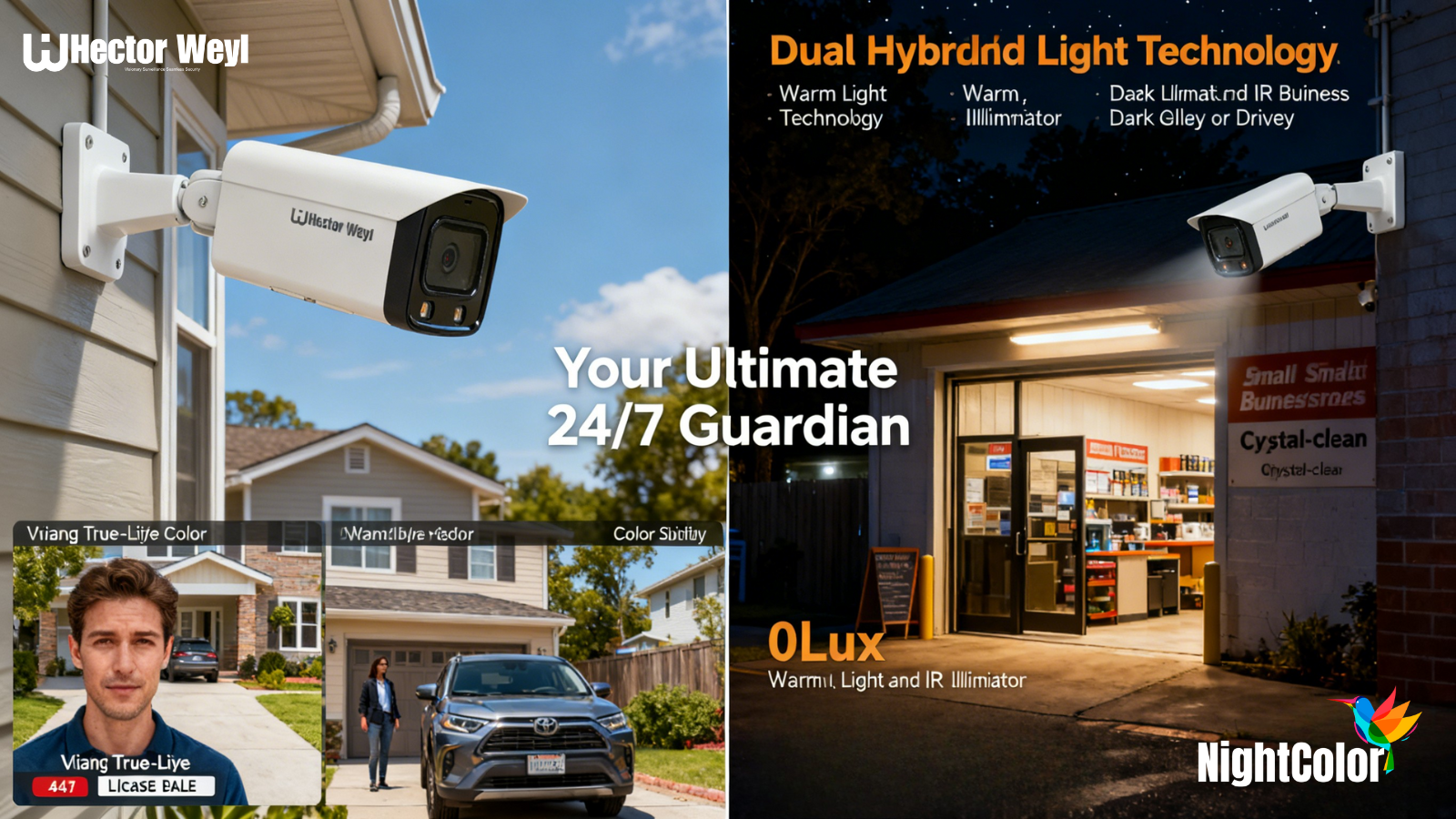
2. Advanced Dual Hybrid Light: Spectral Intelligence
The conflict between Infrared (Zero-Color) and White Light (Light Pollution) is resolved through Intelligent Illumination Routing:
-
Stealth Mode: By default, the system operates in discrete Infrared.
-
Neural Trigger: Upon detecting a human or vehicle signature, the IntelliCore™ engine instantly engages the Warm-Light Full-Color Mode.
-
OPC (Optical Path Compensation): In our CT 2.0 units, OPC technology corrects the refraction angles across the spectrum. Combined with a massive F1.0 Super-Aperture, these cameras harvest maximum light without the glare or "wash-out" associated with inferior white-light systems.

Tactical Pursuit: The Evolution of Target Acquisition
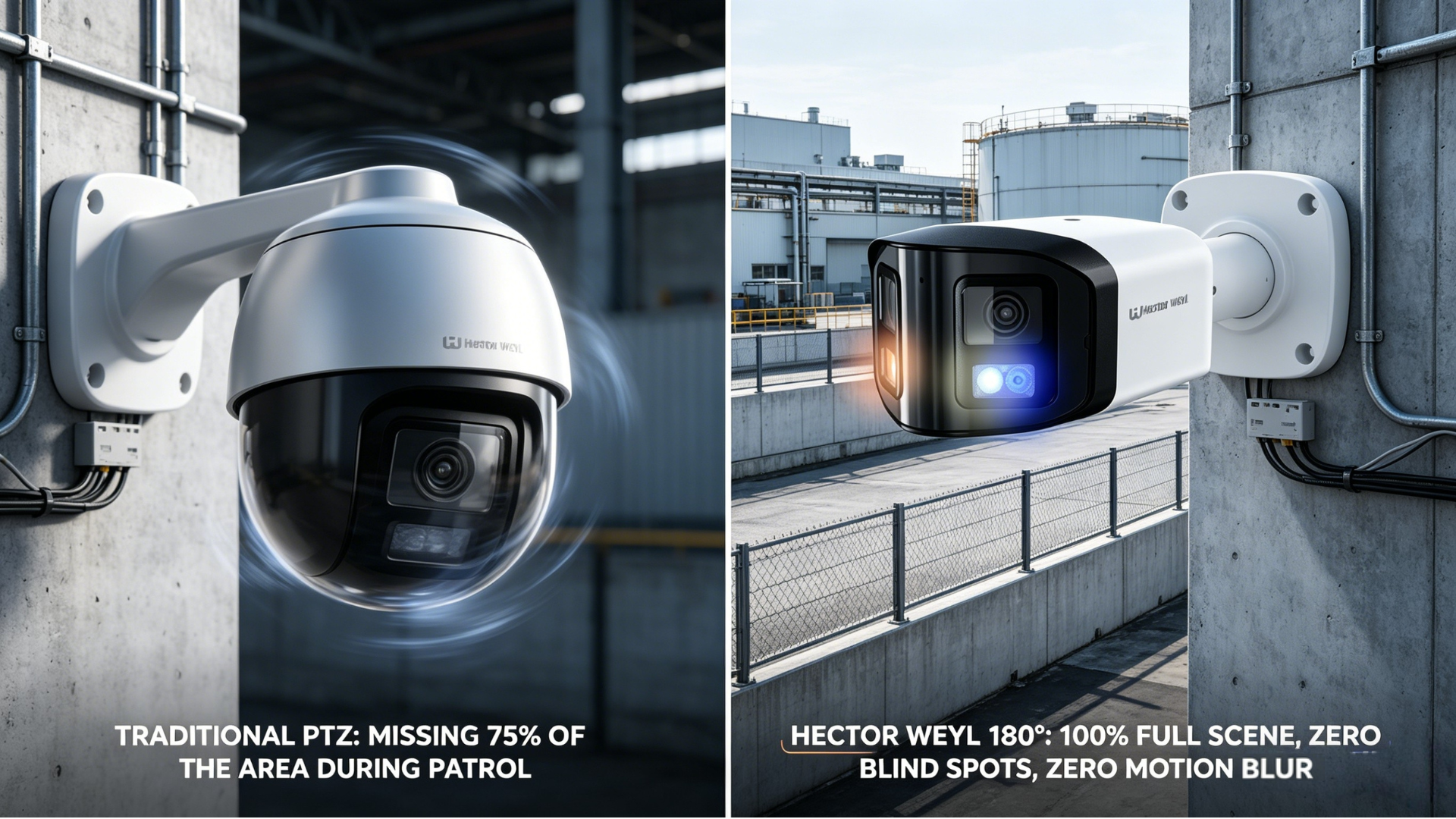
In volatile, low-visibility theaters, manual PTZ intervention is a strategic liability. Human latency is insufficient to maintain a definitive lock on high-velocity or evasive targets. Hector Weyl’s Tractive™ technology resolves this by transforming a passive sensor into an autonomous pursuit engine. By synthesizing complex motion-vector analysis with precision Pan-Tilt-Zoom kinetics, the system ensures that any moving signature remains surgically anchored at the center of the forensic frame.
Tractive™ 3.0: The Neural Hunter
Featured exclusively in the Cerberus-Triad (CT) 2.0 series, Tractive™ 3.0 represents a paradigm shift in autonomous surveillance. Driven by high-density deep-learning frameworks, this architecture transcends basic motion detection to establish Neural Object Sovereignty.
-
Surgical Discrimination: The Tractive™ engine is trained to isolate and prioritize human and vehicle signatures with absolute certainty, effortlessly filtering out environmental noise such as thermal drift, swaying foliage, or shifting shadows.
-
The 870-Meter Kill-Zone: Through the deep integration of predictive auto-focus algorithms, CT 2.0 maintains a fluid, jitter-free "tether" on targets at extreme distances—securing a perimeter up to 870 meters.
-
Micro-Target Acquisition: The Tractive™ 3.0 engine significantly lowers the "Minimum Pixel Threshold." This allows the system to acquire and tether micro-targets—such as a crawling intruder or a distant vessel at the horizon—long before they escalate into a proximal threat.
In any high-stakes perimeter scenario, this is the ultimate deterrent: a Neural Hunter that never loses its grip, never suffers from fatigue, and maintains an unshakeable visual chain of custody throughout the entire engagement.

The New Standard of Nighttime Sovereignty
Continuous technological disruption has finally shattered the legacy constraints of low-light surveillance. While traditional industry players provided the initial tools for basic nighttime imaging, Hector Weyl has redefined the theater of operation. Our mission transcends mere "visibility"—we have established a framework of Sovereign Perception, where the veil of night is no longer a tactical blind spot, but a decisive strategic advantage.
By integrating Cerberus-Triad (CT) 2.0 dual-lens optics, Intelligent Illumination Routing, and the Tractive™ 3.0 "Neural Hunter" engine, users are no longer forced to endure the grainy, compromised imagery of the past. For small and medium-sized enterprises, Hector Weyl offers more than security; we deliver Absolute Deterrence.
Through the synergistic fusion of Tactical Red & Blue visual intervention, high-fidelity auditory deterrence via VoiceTrap™, and surgical target acquisition, we provide a comprehensive perimeter sovereignty that legacy systems simply cannot match. As we look toward the future, Hector Weyl remains committed to the relentless pursuit of spectral mastery—ensuring that your establishments are protected by the most sophisticated, reliable, and intelligent surveillance architecture ever engineered.
This is the end of compromise. This is the era of Hector Weyl.






Share:
Conquering High-Contrast Environments: How True WDR Transforms Building Lobby Surveillance
Revolutionizing Retail Intelligence: How Hector Weyl's IntelliCore People Counting Transforms Operations & Customer Experience