
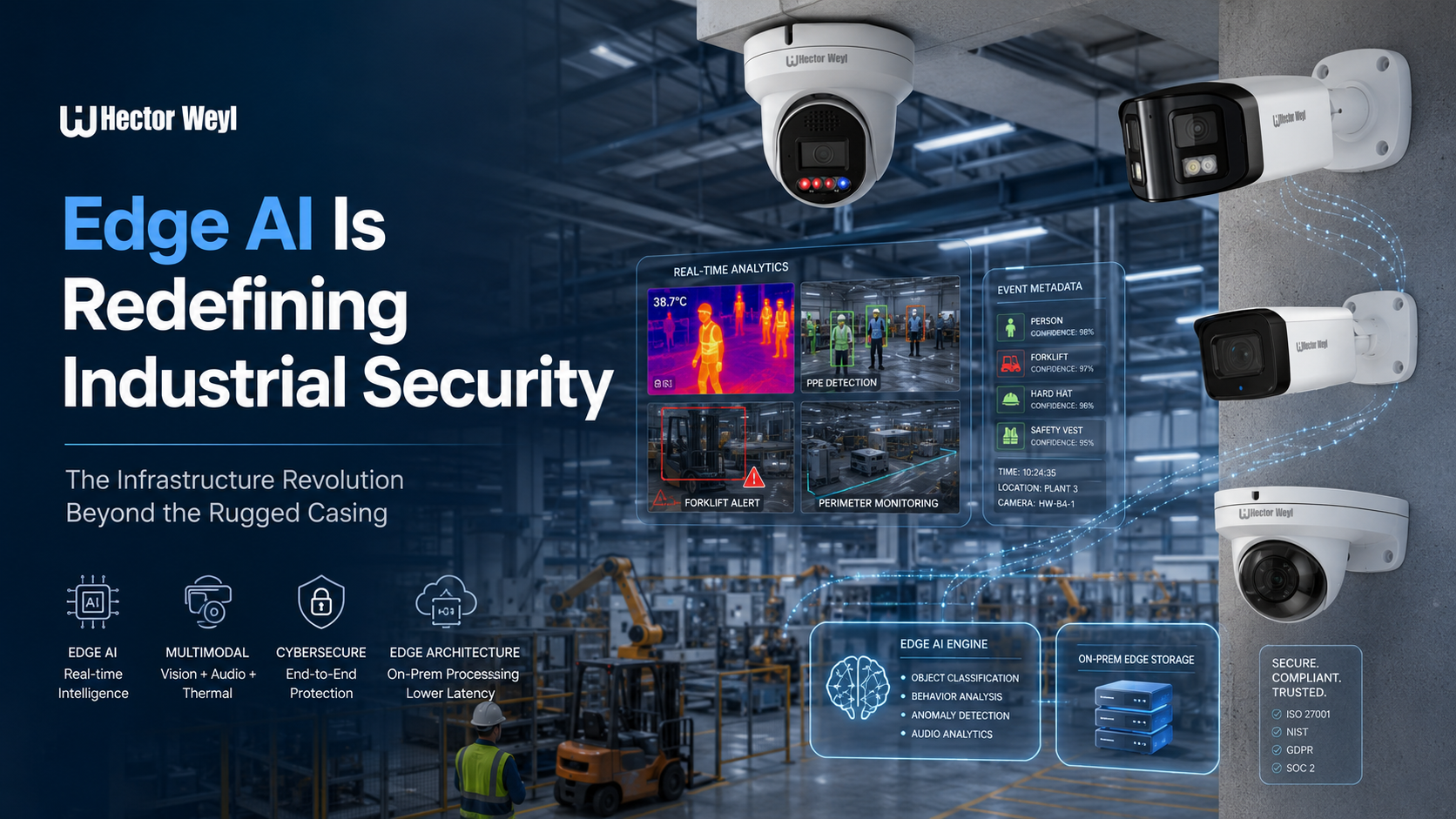
Edge AI is Redefining Industrial Security: The Infrastructure Revolution Beyond the Rugged Casing
Industrial Camera Storage & Edge AI Infrastructure Deep Dive | Hector Weyl Tech Blog
Outdated Thinking: Rugged Casing Is No Longer Enough
For years, industrial video security meant one thing: a rugged casing. Dust, heat, vibration, moisture—if the camera could survive the physical environment, it was considered enough.
That mindset is officially outdated.
Today, while the physical durability of industrial cameras remains critical, the real transformation is happening inside the chassis. As AI inference moves rapidly to the edge, internal memory and storage are facing unprecedented, real-time read/write workloads. This continuous operational pressure would instantly overwhelm consumer-grade components.
Here is what we are seeing on the ground.
1. The Underestimated Data Beast: 24/7 4K and Multimodal Fusion
Industrial facilities never sleep, and neither do their security systems. To meet strict regulatory compliance and continuous safety monitoring, modern industrial video streams must run 24/7 without interruption.
High-Fidelity Requirements
To provide the precise visual data required for AI analytics, cameras routinely record in 4K resolution or higher at frame rates of 30 to 60 fps.
Multimodal Sensor Fusion
Beyond visible light, modern deployments integrate non-visible spectrum sensors—such as infrared thermography for heat signatures and LiDAR for precise movement tracking—directly into the video stream.
Data Volume at a Glance
Even with high compression, a single camera generates roughly 10 to 40 GB of data per day. Multiplied across dozens or hundreds of cameras across a production site, operations must handle terabytes of continuous write traffic daily—and that is before factoring in the AI workload.
2. AI Metadata: How Inference Shatters Linear Storage Patterns
The leap from passive recording to proactive threat prevention is driven by real-time AI inference at the edge and the metadata it generates.
In practice, an AI-enabled camera does not just record footage; it continuously logs structured data (timestamps, temperature anomalies, behavioral alerts). This metadata directly enables high-value applications:
- Early Fire Detection: Catching thermal anomalies via infrared AI before traditional smoke alarms are triggered.
- Automated PPE Compliance: Real-time monitoring of hard hats, high-visibility vests, and protective gear.
- Restricted Zone Access Control: Integrating with access systems to block unauthorized personnel from hazardous areas.
- Forklift Collision Avoidance: Providing blind-spot alerts for both autonomous and operator-driven industrial vehicles.

⚠️ The Silent Killer of Storage Performance
While standard video streams are written in a predictable, linear fashion, AI metadata is highly non-linear and bursty. Triggered by sudden events—a temperature spike, a worker crossing a perimeter, or a forklift approaching a corner—metadata demands instant performance spikes.
According to laboratory data:
- AI-enabled cameras generate up to 10x more random write operations than standard surveillance cameras.
- During peak event windows, AI metadata can account for up to 50% of the total data generated by the camera.
Edge storage must swallow these unpredictable, high-intensity bursts of random writes while simultaneously recording continuous 4K video. Dropping a single frame of video is a failure; losing a single AI metadata vector destroys the intelligence layer that makes the entire system valuable.
3. Hardware Reliability: The Hidden Cost at 15 Meters High
In harsh environments like manufacturing plants, mines, or chemical facilities, hardware failure carries consequences that extend far beyond the price of the component.
| Scenario | Consumer-Grade Storage Failure | Industrial-Grade Edge Storage (e.g., Micron i400) |
|---|---|---|
| Consequences | A minor inconvenience. You swap the card in a few minutes. | Extremely costly. Cameras are often mounted in high-altitude or hazardous zones. |
| Replacement Process | Tool-free swap at ground level with zero operational impact. | 1. Renting scissor lifts or erecting scaffolding. 2. Cordoning off active production zones. 3. Scheduling maintenance windows that cause costly downtime. 4. Deploying specialized, certified technicians. |
| Key Reliability Metrics | No guaranteed durability; highly prone to failure under heat and vibration. | • Mean Time to Failure (MTTF) of 2 million hours • Extended operating temperature range of -25°C to 85°C • High tolerance to continuous industrial vibration • Integrated health monitoring for predictive maintenance |
Predictive maintenance is the holy grail of industrial operations. Utilizing storage devices that alert operators to their remaining lifespan allows teams to replace components during scheduled maintenance windows, completely avoiding emergency production shutdowns.
4. Regulatory Compliance: Data as a Legal Record
Globally, workplace safety regulations (such as OSHA and ISO 45001) are becoming more stringent. For modern enterprises, compliance is no longer just about having a policy—it requires indisputable proof.
Edge security systems have transitioned into the central pillars of enterprise compliance, tasked with:
- Verifying worker certifications before granting high-risk area access.
- Documenting the end-to-end handling of hazardous materials.
- Providing audit-ready, tamper-proof evidence if an incident occurs.
Consequently, video footage and AI metadata are no longer just operational tools; they are legal records. Data loss or corruption directly exposes a company to heavy fines, legal liability, and catastrophic reputational damage.
Conclusion: How Hector Weyl Defines Infrastructure Security
At Hector Weyl, we are a camera company, not a memory manufacturer. However, we pay fanatical attention to what goes inside our cameras.
We know that a system with the world's finest lenses and the most sophisticated AI algorithms is completely compromised if it is bottlenecked by sub-par storage that fails in the field.
We collaborate deeply with industry leaders like Micron to ensure that Hector Weyl’s industrial AI cameras are equipped with industrial-grade DRAM and microSD storage engineered for the extreme.
The lens captures the scene. The AI provides the intellect. But it is the industrial storage architecture that ensures the entire system works continuously, reliably, and predictably.
🔍 Is your industrial security system bottlenecked by edge storage limits?
Contact a Hector Weyl technical expert today to evaluate the intelligence and resilience of your current deployment.






Share:
Stream Cipher: The Unsung Hero Securing Surveillance Data in Intelligent Security Systems
Smart Stadium Surveillance: Beyond Security, Towards Intelligence