
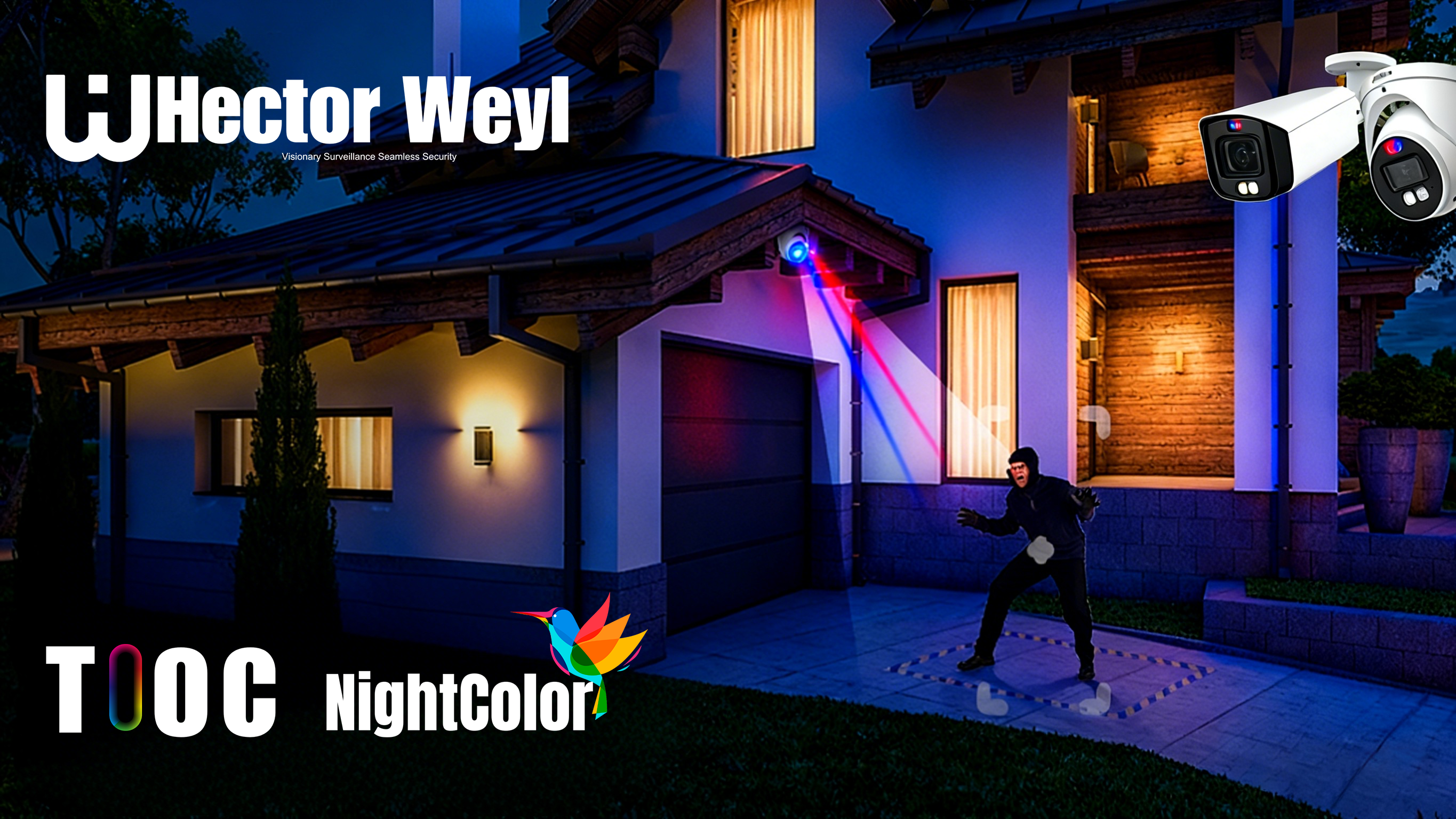
Introduction: The Evolution of Video Surveillance—From Passive Recording to Pro-active Protection

Video surveillance has come a long way since its inception as a simple tool for post-event documentation. In the early days, closed-circuit television (CCTV) systems relied on analog cameras and manual monitoring, offering little more than a retrospective view of incidents. As technology advanced, digital cameras and networked systems emerged, but many remained rooted in a "passive" paradigm: recording footage 24/7, with no real-time intervention or deterrence. For decades, users were forced to sift through hours of uneventful video to investigate crimes or incidents—a time-consuming, resource-draining process that often left them reactive rather than proactive.
Today, the landscape is shifting dramatically. With the rise of artificial intelligence (AI), advanced sensor technology, and smart illumination systems, pro-active video surveillance has emerged as a game-changer. Unlike passive systems that wait for incidents to occur, pro-active solutions anticipate, deter, and respond to threats in real time, empowering users to protect their properties, assets, and loved ones before harm is done. At the forefront of this revolution is Hector Weyl, a leader in intelligent video solutions with over 15 years of innovation. The company’s TiOC (Three-in-One Camera) technology—combining Advanced Dual Light Illuminators, Active Deterrence, and AI-powered analytics—paired with Full-color "Night Color Technology," is redefining what video surveillance can achieve.
In this comprehensive guide, we’ll explore the fundamental differences between passive and pro-active surveillance, dive deep into the technical mechanics of Hector Weyl’s cutting-edge solutions, and examine how these technologies deliver tangible benefits to users across residential, commercial, and industrial settings. From reducing false alarms to enabling 24/7 full-color monitoring, we’ll uncover why pro-active surveillance is no longer a luxury but a necessity for modern security.
Chapter 1: Passive vs. Pro-active Video Surveillance—A Paradigm Shift
1.1 The Limitations of Passive (Traditional) Surveillance
Passive video surveillance is the most common form of security monitoring in use today—yet it is inherently flawed. At its core, passive surveillance operates on a "record-first, act-later" model. Cameras are mounted to capture footage of their field of view, but they lack the ability to distinguish between genuine threats and harmless activity (e.g., a swaying tree branch, a stray cat, or passing car headlights). The burden of monitoring falls entirely on human operators, who must watch live feeds or review hours of recorded video to identify incidents.
This approach suffers from three critical drawbacks:
- Reactivity, not proactivity: By the time an incident is detected (often hours or days later), the damage is already done. Passive surveillance cannot prevent crimes, theft, or vandalism—only document them.
- High false alarm rates: Without intelligent filtering, passive systems trigger alarms for trivial events, leading to "alarm fatigue" among operators who may ignore genuine threats.
- Resource inefficiency: Constant monitoring requires teams of staff, which is costly for businesses and impractical for residential users. A single operator can only effectively monitor 4-6 camera feeds at once; beyond that, attention lapses are inevitable.
For example, a small retail store using passive surveillance might record a break-in overnight, but the owner won’t discover the incident until they review footage the next morning—too late to stop the theft or apprehend the intruder. Similarly, a homeowner relying on traditional cameras might miss a trespasser until they check their DVR, long after the individual has left.
1.2 The Rise of Pro-active Surveillance: What Makes It Different?
Pro-active video surveillance flips the script. Instead of waiting for incidents to unfold, it uses technology to prevent, deter, and respond in real time. At the heart of pro-active systems is a combination of AI-driven analytics, smart sensors, and active deterrence features—all working together to reduce human intervention and increase security effectiveness.
Key characteristics of pro-active surveillance include:
- Intelligent target detection: AI algorithms distinguish between relevant targets (humans, vehicles) and non-threatening objects (animals, debris), eliminating false alarms.
- Real-time deterrence: When a threat is detected, the system activates deterrence measures (e.g., sirens, flashing lights, voice alerts) to scare off intruders before they act.
- Instant notifications: Users receive alerts via mobile apps or email the moment an incident occurs, allowing them to respond immediately (e.g., contact law enforcement, speak to the intruder via two-way audio).
- Efficient data management: By only recording and alerting on relevant events, pro-active systems reduce storage costs and eliminate the need for endless video review.
Hector Weyl’s pro-active solutions take this a step further with TiOC (Three-in-One Camera) technology, which integrates three core capabilities—Advanced Dual Light Illuminators, Active Deterrence, and AI—into a single, seamless system. This integration ensures that users not only detect threats but also have the tools to stop them in their tracks.
1.3 Why Pro-active Surveillance Is Essential Today
The global security landscape is growing increasingly complex. According to a 2024 report by Markets and Markets, the global video surveillance market is projected to reach $97.7 billion by 2028, driven by rising concerns about theft, vandalism, and public safety. However, the sheer volume of surveillance data—estimated to exceed 200 exabytes annually—has made passive systems obsolete.
Pro-active surveillance addresses this challenge by prioritizing quality over quantity. By focusing only on critical events, it reduces the cognitive load on users and operators, while delivering faster, more effective security. For businesses, this translates to lower labor costs, reduced losses from theft, and improved compliance with safety regulations. For homeowners, it means peace of mind knowing their property is protected 24/7, even when they’re away.
As Hector Weyl’s CEO noted in a recent interview: “Pro-active surveillance isn’t just about technology—it’s about empowering users to take control of their security. We’ve moved beyond the days of ‘set-it-and-forget-it’ cameras; today’s users demand systems that work with them to prevent incidents, not just record them.”
Chapter 2: TiOC (Three-in-One Camera) Technology—The Core of Pro-active Security
Hector Weyl’s TiOC (Three-in-One Camera) is the cornerstone of its pro-active surveillance lineup. Designed to address the limitations of traditional cameras, TiOC combines three critical features into a single, compact device: Advanced Dual Light Illuminators, Active Deterrence, and AI-powered analytics. This integration creates a self-contained security solution that is easy to install, simple to use, and highly effective across a range of scenarios—from residential villas to large warehouses.
2.1 Advanced Dual Light Illuminators: Flexibility Without Compromise
At the heart of TiOC’s performance is its Advanced Dual Light Illuminator system, which redefines how surveillance cameras handle lighting challenges. Traditional cameras rely on either infrared (IR) light (for black-and-white night vision) or constant white light (for color footage), but both have drawbacks: IR produces grainy, monochrome images that lack detail, while constant white light wastes energy and causes light pollution.
Hector Weyl’s Dual Light technology solves this by offering three adaptive illumination modes, each tailored to specific environments and user needs:
2.1.1 IR Mode: Stealthy Night Monitoring
IR Mode activates only the camera’s infrared illuminators, emitting a invisible light that is undetectable to the human eye. This mode is ideal for light-sensitive areas such as residential neighborhoods, wildlife reserves, or quiet commercial districts where constant lighting would be disruptive. IR Mode provides clear black-and-white footage at distances of up to 60 meters (depending on the model), ensuring surveillance without disturbing nearby residents or wildlife.
Key benefits of IR Mode:
- Zero light pollution: No visible glow, making it discreet and environmentally friendly.
- Energy efficiency: Uses minimal power compared to constant white light.
- Reliable in total darkness: Captures footage even when ambient light is nonexistent (0 Lux).
2.1.2 Warm Light Mode: Full-Color 24/7
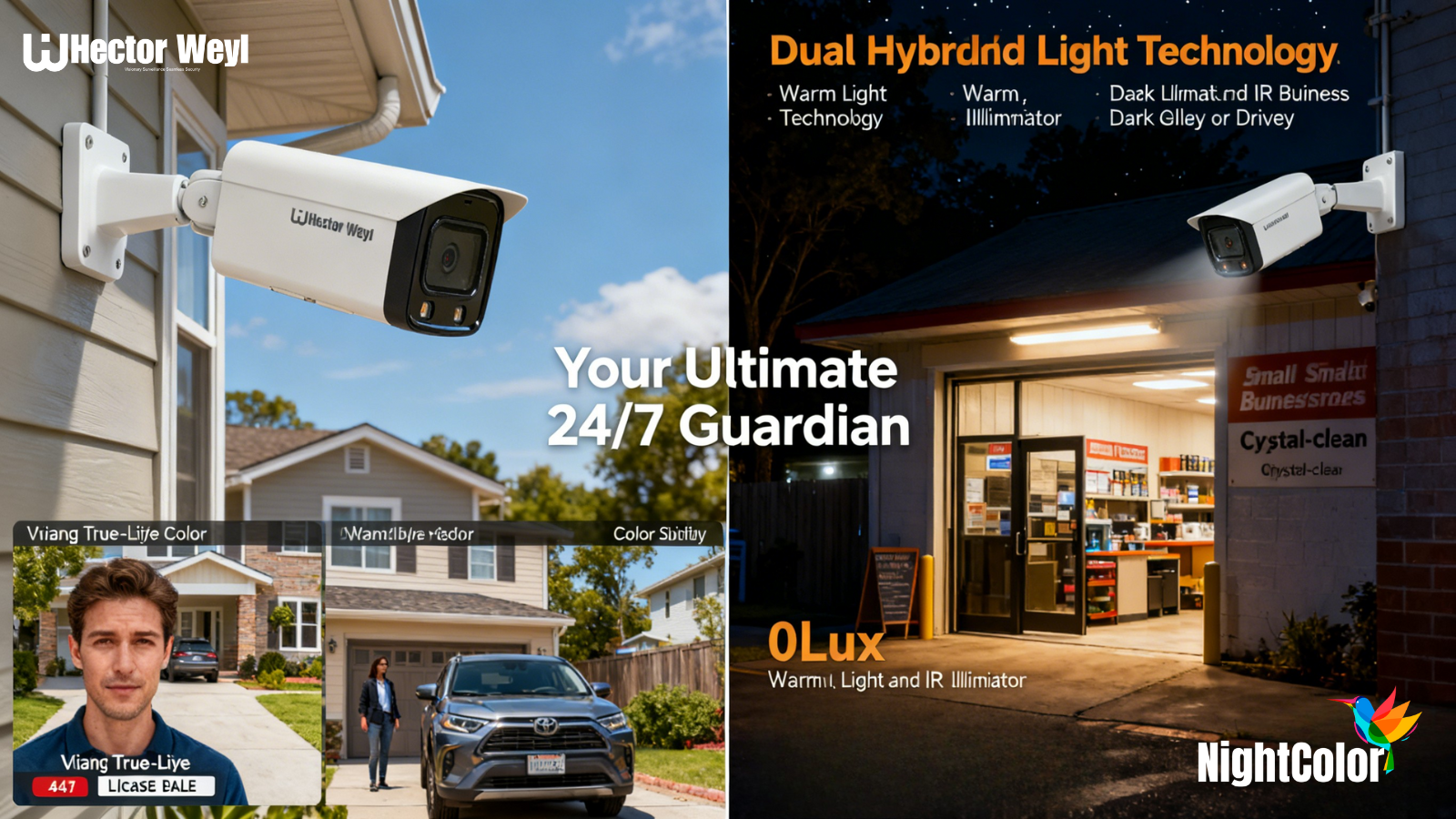
Warm Light Mode activates the camera’s soft white illuminators, bathing the monitored area in a gentle glow that captures vivid, full-color footage day and night. This mode is perfect for areas where color detail is critical—such as retail stores (to identify clothing colors or product details), parking lots (to read license plates), or entryways (to recognize faces). Warm Light Mode has a range of up to 50 meters, with adjustable brightness to avoid overexposure.
Key benefits of Warm Light Mode:
- Color accuracy: Captures true-to-life colors, even in low-light conditions.
- Deterrence by visibility: The presence of visible light can discourage potential intruders.
- Versatility: Works in both indoor and outdoor environments.
2.1.3 Smart Dual Light Mode: Adaptive Illumination
Smart Dual Light Mode is TiOC’s default setting—and its most innovative. Using AI algorithms, the camera automatically switches between IR and Warm Light based on real-time activity. When no target is detected, it uses IR Mode to conserve energy and reduce light pollution. When a human or vehicle enters the monitored area, it instantly switches to Warm Light Mode to capture full-color footage of the event. Once the target leaves, it reverts to IR Mode.

This adaptive approach offers the best of both worlds: discreet monitoring when nothing is happening, and detailed color footage when it matters most. It also reduces false alarms by ensuring that only genuine threats trigger the switch to Warm Light—unlike traditional cameras that activate lighting for any movement.
Technical deep dive: How Smart Dual Light Mode works
TiOC’s Smart Dual Light Mode relies on a combination of passive infrared (PIR) sensors and AI target recognition. The PIR sensor detects changes in heat and motion, while the AI algorithm analyzes the shape and movement of the detected object to confirm it is a human or vehicle (not a pet, tree branch, or wind-blown debris). Only when both sensors confirm a genuine threat does the camera switch to Warm Light Mode. This two-step verification ensures precision and reduces unnecessary lighting.

2.2 Active Deterrence: Stopping Threats Before They Escalate
One of the biggest advantages of pro-active surveillance is its ability to deter intruders in real time—and TiOC’s Active Deterrence features are designed to do just that. When a target is detected in a restricted area (defined by the user via motion zones), the camera activates a multi-layered deterrence system to scare off intruders and alert users:
2.2.1 Red & Blue Warning Lights
TiOC cameras are equipped with high-visibility red and blue LED lights that flash rapidly when a threat is detected. These lights mimic the appearance of law enforcement vehicles, creating an immediate sense of urgency and making intruders aware they are being monitored. The flashing pattern is designed to be disorienting, discouraging further movement.
2.2.2 Audible Siren
The camera’s built-in siren emits a loud, 110-decibel alarm (equivalent to a rock concert or ambulance siren) that can be heard from up to 100 meters away. The siren is customizable—users can choose from pre-recorded messages (e.g., “Warning: You are entering a restricted area. Please leave immediately”) or a standard alarm tone. For commercial users, custom messages can include company names or emergency contact information.
2.2.3 Real-Time Notifications
In addition to on-site deterrence, TiOC sends instant alerts to users’ mobile devices via the Hector Weyl app. Alerts include a snapshot of the incident and a link to live video, allowing users to assess the situation and take action—whether that’s calling the police, speaking to the intruder via two-way audio (available on select models), or activating additional security measures (e.g., locking doors, turning on other lights).
Case study: How Active Deterrence stopped a break-in at a small business
A family-owned convenience store in Chicago installed Hector Weyl’s TiOC cameras in 2023. One night, at 2:30 AM, the camera detected an intruder attempting to pry open the front door. Within seconds, the camera activated its red & blue lights and siren. The intruder fled the scene immediately, and the store owner received a notification on their phone. Police arrived within 5 minutes, but the threat had already been neutralized—all thanks to TiOC’s real-time deterrence.
“We used to worry about break-ins every night,” the owner said. “Now, we sleep soundly knowing the camera will alert us and scare off intruders before they can do any damage.”
2.3 AI-Powered Analytics: Precision Detection, Minimal False Alarms
The success of pro-active surveillance hinges on its ability to distinguish between genuine threats and false positives—and TiOC’s AI-powered analytics are the key to this precision. Hector Weyl’s proprietary Active Motion Detection (AMD) and Perimeter Protection algorithms are trained on millions of images to accurately identify humans and vehicles, while ignoring non-threatening objects like animals, leaves, rain, or car headlights.
2.3.1 Active Motion Detection (AMD)
AMD goes beyond traditional motion detection by analyzing the shape, size, and movement pattern of detected objects. For example:
- A human walking upright will trigger an alarm, but a cat running across the yard will not.
- A car entering a parking lot will be detected, but a tree branch swaying in the wind will be ignored.
- A person loitering near a window will trigger an alert, but a bird flying past will not.
This level of precision reduces false alarms by up to 95% compared to traditional cameras, according to internal Hector Weyl testing. For users, this means fewer unnecessary notifications and more confidence that alerts are genuine.
2.3.2 Perimeter Protection
Perimeter Protection allows users to define virtual “no-go zones” (e.g., a fence line, a storefront window, a warehouse loading dock). The AI algorithm monitors these zones 24/7 and triggers an alarm only when a human or vehicle crosses the boundary. Users can customize the sensitivity of the perimeter—for example, setting a “warning zone” that triggers a siren only if a target lingers for more than 10 seconds, or an “alert zone” that triggers an immediate response.
Technical deep dive: How AMD and Perimeter Protection work
Hector Weyl’s AI algorithms use deep learning models—specifically convolutional neural networks (CNNs)—to classify objects in real time. The CNNs are trained on a diverse dataset of images and videos, covering different lighting conditions, weather scenarios, and object types. This training enables the algorithm to recognize humans and vehicles with 99% accuracy, even in low light or adverse weather (e.g., rain, fog, snow).
The algorithms also adapt to the camera’s environment over time. For example, if a tree branch sways in the wind every day, the camera will learn to ignore it, further reducing false alarms. This self-learning capability ensures that the camera becomes more accurate the longer it is in use.
2.3.3 Scheduled Monitoring Modes
TiOC’s AI analytics are not one-size-fits-all—users can schedule different monitoring modes for different times of day. For example:
- A retail store can set “high-sensitivity” mode during closing hours (to detect intruders) and “low-sensitivity” mode during business hours (to ignore customers moving around the store).
- A residential user can set “away mode” when they’re on vacation (full AI detection, active deterrence) and “home mode” when they’re at home (only detect targets in restricted areas, no siren to avoid disturbing the family).
This flexibility makes TiOC suitable for a wide range of use cases, from 24/7 industrial facilities to homes with variable security needs.
Chapter 3: Full-color "Night Color Technology"—Seeing Clearly After Dark
For decades, night vision in video surveillance meant grainy, black-and-white footage. While IR cameras solved the problem of recording in darkness, they lacked the color detail needed to identify faces, clothing, or license plates—critical for post-event investigation. Hector Weyl’s Full-color “Night Color Technology” changes this, delivering vivid, full-color footage even in near-total darkness (0.0007 Lux) and redefining what’s possible with night-time surveillance.
3.1 How Night Color Technology Works
Night Color Technology is the result of three key innovations: advanced image sensors, optimized lens design, and intelligent exposure control. Together, these components work to capture more light, reduce noise, and preserve color accuracy—even in the darkest environments.
3.1.1 High-Sensitivity Image Sensors
TiOC cameras use 1/1.8” or 1/2.7” CMOS sensors (depending on the model) with ultra-high sensitivity. These sensors are designed to capture more photons (light particles) in low light, reducing the need for artificial illumination. Unlike traditional sensors that produce noisy images in darkness, Hector Weyl’s sensors use backside illumination (BSI) technology, which places the sensor’s photodiodes on the back of the chip (instead of the front) to minimize light loss. This results in cleaner, more detailed images with less grain.
3.1.2 Wide-Aperture Lenses
TiOC cameras are equipped with fixed-focal lenses with a maximum aperture of F1.0–F1.6 (depending on the model). A wider aperture allows more light to enter the camera, improving low-light performance. For example, an F1.0 aperture lets in 4x more light than an F2.0 aperture—critical for capturing color in near-darkness. The lenses are also coated with anti-reflective materials to reduce glare and improve contrast.
3.1.3 Intelligent Exposure Control
To avoid overexposure from artificial lights (e.g., streetlights, car headlights) and preserve color accuracy, TiOC uses intelligent exposure control. The camera adjusts its shutter speed and ISO settings in real time, ensuring that bright areas (e.g., a flashing siren) don’t wash out dark areas (e.g., a person’s face). This technology also prevents motion blur, even when capturing moving targets in low light.
3.1.4 Dual Light Synergy
Night Color Technology works seamlessly with TiOC’s Dual Light Illuminators. In Smart Dual Light Mode, the camera uses IR light for stealthy monitoring when no targets are detected, but switches to Warm Light Mode when a threat is identified—ensuring that the critical moment is captured in full color. This synergy means users get the best of both worlds: discreet monitoring and detailed color footage when it matters most.
3.2 Night Color vs. Traditional Night Vision: A Comparison
To understand the impact of Night Color Technology, let’s compare it to traditional night vision solutions:
| Feature | Traditional IR Cameras | Hector Weyl Night Color Technology |
|---|---|---|
| Image Type | Black-and-white | Full-color (day and night) |
| Low-Light Performance | Grainy, noisy (0.1 Lux minimum) | Clear, detailed (0.0007 Lux minimum) |
| Detail Recognition | Poor (cannot identify faces/clothing) | Excellent (identifies faces, license plates, clothing) |
| Light Pollution | Low (invisible IR) | Low (adaptive Warm Light only when needed) |
| Energy Efficiency | High | High (adaptive illumination) |
Case study: Night Color Technology solves a hit-and-run investigation
A restaurant in Miami installed Hector Weyl’s TiOC cameras in its parking lot. One night, a hit-and-run driver damaged several cars before fleeing the scene. Thanks to Night Color Technology, the camera captured clear, full-color footage of the driver’s face and the vehicle’s license plate—even though the incident occurred at 3:00 AM with no ambient light. Police used the footage to identify and arrest the driver within 48 hours.
“Without the color footage, we would have had no way to identify the driver,” the restaurant manager said. “Traditional IR cameras would have given us a blurry black-and-white image, but Hector Weyl’s technology gave us the detail we needed to solve the case.”
3.3 The Benefits of Full-Color Night Surveillance
Full-color night vision isn’t just a “nice-to-have”—it delivers tangible benefits for users:
- Faster investigations: Color footage makes it easier to identify suspects, vehicles, and evidence (e.g., a stolen laptop’s color, a suspect’s jacket).
- Improved prosecution rates: Clear, color evidence is more likely to hold up in court than grainy black-and-white footage.
- Peace of mind: Users can see exactly what’s happening on their property at night, without guessing.
- Versatility: Works in both indoor and outdoor environments, from dark alleys to poorly lit warehouses.
Chapter 4: Applications—TiOC and Full-Color Technology in Action
Hector Weyl’s pro-active surveillance solutions are designed to adapt to a wide range of use cases, from residential homes to large industrial facilities. Below are some of the most common applications, along with how TiOC and Full-Color Technology deliver value:
4.1 Residential Security (Villas, Homes, Gated Communities)
Residential users need security that is discreet, effective, and easy to use—and TiOC delivers on all three fronts. Key benefits for homeowners:
- 24/7 protection: Full-color night vision lets users monitor their property after dark, while Active Deterrence scares off intruders before they can break in.
- Reduced false alarms: AI motion detection ignores pets and wildlife, so users don’t receive unnecessary notifications.
- Remote monitoring: The Hector Weyl app allows users to check live feeds, review footage, and control the camera from anywhere in the world.
- Discreet design: TiOC cameras are compact and weatherproof (IP67 rating), blending into residential environments without being obtrusive.
Example: A family in Los Angeles uses TiOC cameras to monitor their home while they’re on vacation. One day, they received an alert that someone was loitering near their garage. Using the app, they viewed live full-color footage of the individual and activated the siren. The person fled immediately, and the family was able to share the footage with their neighborhood watch group.
4.2 Commercial Retail (Stores, Boutiques, Shopping Malls)
Retail businesses face unique security challenges: theft (both internal and external), vandalism, and the need to monitor customer activity without disrupting the shopping experience. TiOC’s benefits for retailers:
- Loss prevention: Active Deterrence stops shoplifters in their tracks, while Full-color footage identifies perpetrators for prosecution.
- Employee monitoring: Perimeter Protection can be set to monitor restricted areas (e.g., stock rooms, cash registers) without interfering with customer areas.
- Customer safety: The siren and warning lights can be activated in case of emergencies (e.g., fights, medical incidents) to alert staff and customers.
- Analytics integration: Select TiOC models work with Hector Weyl’s VMS Pro software to track foot traffic and customer behavior, helping retailers optimize store layout and staffing.
Example: A clothing boutique in New York City installed TiOC cameras near its high-end merchandise displays. Within a month, the camera detected a shoplifter attempting to steal a leather jacket. The siren and warning lights activated, and the shoplifter dropped the jacket and fled. The boutique owner reviewed the full-color footage and shared it with local police, who identified the individual as a repeat offender.
4.3 Industrial & Warehouse Security
Warehouses and industrial facilities require security that can cover large areas, withstand harsh conditions, and protect valuable inventory. TiOC’s key benefits for industrial users:
- Wide coverage: Dual Light Illuminators cover up to 60 meters, making TiOC ideal for large warehouses and outdoor yards.
- Weather resistance: IP67 and IK10 ratings (on select models) protect the camera from dust, water, and physical damage (e.g., vandalism, falling debris).
- 24/7 operation: Full-color night vision and AI detection ensure that inventory is protected even during overnight shifts.
- Integration with existing systems: TiOC cameras are compatible with Hector Weyl’s NVRs and VMS software, allowing for centralized monitoring of multiple cameras.
Example: A logistics warehouse in Houston uses 15 TiOC cameras to monitor its 50,000-square-foot facility. One night, a camera detected an intruder cutting through a fence. The siren activated, and the warehouse manager received an alert. By the time security arrived, the intruder had fled—but the full-color footage allowed them to identify the individual and repair the fence before any inventory was stolen.
4.4 Public Spaces (Parks, Parking Lots, Office Buildings)
Public spaces require security that balances safety with privacy and accessibility. TiOC’s benefits for public spaces:
- Discreet monitoring: IR Mode ensures that surveillance doesn’t disrupt public activities, while Warm Light Mode activates only when needed.
- Crowd management: Perimeter Protection can be set to monitor overcrowded areas, triggering alerts if crowds exceed a certain size.
- Emergency response: The siren and warning lights can be activated to alert authorities in case of incidents (e.g., fights, suspicious packages).
- Access control: TiOC can be integrated with access control systems to monitor entry points and prevent unauthorized access.
Example: A municipal park in Seattle installed TiOC cameras to monitor its trails and parking lot. One evening, the camera detected a group of individuals vandalizing a picnic shelter. The siren activated, and park rangers received an alert. They arrived within 10 minutes and apprehended the individuals, using the full-color footage as evidence.
Chapter 5: User Benefits—Beyond Security
While security is the primary goal of TiOC and Full-Color Technology, users gain a range of additional benefits that improve efficiency, reduce costs, and enhance peace of mind:
5.1 Cost Savings
- Reduced labor costs: Pro-active surveillance eliminates the need for 24/7 human monitoring, saving businesses thousands of dollars annually.
- Lower insurance premiums: Many insurance companies offer discounts for businesses and homeowners with pro-active security systems, as they are less likely to file claims.
- Minimal maintenance: TiOC cameras are designed for durability, with long-lasting LEDs (50,000 hours) and weatherproof casings that require little upkeep.
5.2 Time Efficiency
- Faster incident response: Real-time alerts and remote monitoring mean users can respond to incidents in minutes, not hours.
- Simplified footage review: AI filtering means users only need to review footage of genuine incidents, not hours of uneventful video.
- Easy installation: TiOC cameras are plug-and-play, with PoE (Power over Ethernet) support for easy wiring.
5.3 Peace of Mind
- 24/7 protection: Users can rest assured that their property is protected day and night, even when they’re away.
- Transparency: Full-color footage provides clear visibility into what’s happening on the property, eliminating guesswork.
- Control: The Hector Weyl app puts users in control of their security, allowing them to adjust settings, view feeds, and activate deterrence features from anywhere.
5.4 Environmental Sustainability
- Reduced energy use: Adaptive Dual Light Mode uses only the necessary illumination, reducing energy consumption compared to constant white light cameras.
- Lower carbon footprint: Durable design and minimal maintenance mean fewer cameras end up in landfills.
- Light pollution reduction: IR Mode and adaptive lighting minimize the impact on local ecosystems and nearby residents.
Chapter 6: The Future of Pro-active Surveillance
As technology continues to evolve, Hector Weyl is at the forefront of innovation in pro-active surveillance. Here are some of the key trends shaping the future of the industry—and how Hector Weyl is leading the way:
6.1 AI Advancements
- More accurate object recognition: Future AI algorithms will be able to distinguish between specific individuals (with user consent), vehicles, and even objects (e.g., a stolen laptop).
- Predictive analytics: Cameras will use machine learning to identify patterns of behavior that indicate potential threats (e.g., a person loitering near a window multiple times in a week).
- Edge computing: AI processing will move from the cloud to the camera itself, reducing latency and improving real-time response.
6.2 Integration with Smart Home/Office Systems
- Seamless connectivity: TiOC cameras will integrate with smart locks, lights, and alarms, creating a unified security ecosystem. For example, if a camera detects an intruder, it can automatically lock doors and turn on all lights.
- Voice control: Users will be able to control their cameras using voice assistants (e.g., Alexa, Google Assistant).
- IoT integration: Cameras will communicate with other IoT devices (e.g., motion sensors, smoke detectors) to provide a holistic security solution.
6.3 Enhanced Imaging Technology
- Higher resolution: Future cameras will offer 12MP+ resolution, capturing even more detail in full color.
- Better low-light performance: Advances in sensor technology will allow cameras to capture color footage in near-total darkness (0 Lux) without artificial illumination.
- 360-degree coverage: Panoramic cameras with AI stitching will eliminate blind spots, providing complete coverage of large areas.
6.4 Privacy-Focused Features
- Privacy zones: Users will be able to define areas where the camera does not record (e.g., neighboring yards, windows) to comply with privacy regulations.
- Encryption: Footage will be encrypted end-to-end, protecting user data from hackers.
- Anonymous monitoring: AI algorithms will be able to detect threats without identifying individuals, balancing security and privacy.
Hector Weyl’s commitment to innovation is evident in its ongoing research and development. The company invests 15% of its annual revenue in R&D, with a focus on AI, imaging, and sustainability.
As CEO noted: “Our goal is to make pro-active surveillance accessible to everyone—from homeowners to large enterprises—while maintaining the highest standards of privacy, accuracy, and reliability.”
Chapter 7: Choosing the Right Pro-active Surveillance System
With so many surveillance options on the market, choosing the right system can be overwhelming. Below are key factors to consider when selecting a pro-active surveillance solution—along with why Hector Weyl’s TiOC and Full-Color Technology stand out:
7.1 Key Considerations
- AI accuracy: Look for systems with proven false alarm reduction (ideally 90%+). Hector Weyl’s AMD algorithm achieves 95% false alarm reduction.
- Illumination flexibility: Ensure the system offers adaptive lighting options to avoid light pollution and save energy.
- Deterrence features: Red & blue lights, sirens, and real-time notifications are critical for stopping threats.
- Image quality: Full-color night vision with high resolution (4MP+) is essential for identification.
- Durability: IP67+ weather resistance and IK10 vandal resistance ensure the system lasts in harsh environments.
- Ease of use: A user-friendly app and plug-and-play installation make the system accessible to non-technical users.
- Integration: Compatibility with NVRs, VMS software, and smart home/office systems adds value.
7.2 Why Hector Weyl Stands Out
- 15+ years of expertise: Hector Weyl is a leader in intelligent video solutions, with a track record of innovation and reliability.
- All-in-one design: TiOC combines three critical features (Dual Light, Active Deterrence, AI) into a single camera, reducing complexity and cost.
- Superior image quality: Full-color night vision with 0.0007 Lux sensitivity outperforms competitors.
- Global support: Hector Weyl has a worldwide network of distributors and technical support teams, ensuring users get help when they need it.
- Customization: Cameras are available in a range of models (4MP, 5MP, 8MP) to suit different needs and budgets.
7.3 Getting Started with Hector Weyl
Getting started with Hector Weyl’s pro-active surveillance system is simple:
- Assess your needs: Identify the areas you need to monitor, your budget, and key features (e.g., full-color night vision, two-way audio).
- Choose the right model: Select a TiOC model based on resolution, illumination range, and features (e.g., HW-IPC-F5819E-IL-ZAS-PV for 8MP resolution and 50m illumination).
- Install the camera: TiOC cameras are easy to install with PoE support—no separate power cable needed.
- Set up the app: Download the Hector Weyl app, connect the camera to your network, and customize your monitoring settings (motion zones, deterrence preferences).
- Enjoy peace of mind: Monitor your property remotely, receive real-time alerts, and rest easy knowing you’re protected by pro-active security.
Conclusion: The Future of Security Is Pro-active
Video surveillance has evolved from a passive tool for post-event documentation to a pro-active system that prevents threats, deters intruders, and empowers users. Hector Weyl’s TiOC (Three-in-One Camera) and Full-color “Night Color Technology” are at the forefront of this evolution, offering a seamless combination of AI-powered accuracy, adaptive illumination, and real-time deterrence.
Whether you’re a homeowner looking to protect your family, a business owner aiming to reduce theft, or a facility manager responsible for large-scale security, pro-active surveillance delivers tangible benefits: reduced costs, faster response times, improved evidence quality, and peace of mind. With Hector Weyl’s commitment to innovation, the future of security is brighter—and more secure—than ever before.
As threats continue to evolve, so too will surveillance technology. But one thing remains constant: the need for systems that work with users to prevent incidents, not just record them. Pro-active video surveillance is no longer a luxury—it’s a necessity for anyone who values safety, security, and peace of mind.
Call to Action
Ready to upgrade to pro-active surveillance with Hector Weyl’s TiOC and Full-color Technology? Visit our website (www.hectorweyl.com) to explore our range of cameras, request a demo, or contact a local distributor. Protect what matters most—today and tomorrow.
About Hector Weyl
Hector Weyl is a leading professional manufacturer of intelligent video solutions, with over 15 years of experience in the CCTV industry. Headquartered in shenzhen, the company specializes in IP cameras, NVRs, PoE switches, and VMS software, with a focus on AI, full-color night vision, and pro-active deterrence. Hector Weyl’s products are used in over 100 countries worldwide, trusted by homeowners, businesses, and government organizations for their reliability, innovation, and performance. For more information, visit www.hectorweyl.com.






Share:
A Beginner’s Guide to TCP/IP Settings for Hector Weyl Network Cameras
Hector Weyl Advanced Dual Hybrid Illuminators: Pioneering a New Era of Full-Color Night Surveillance